
Table of Contents
Batch Coding Best Practices for Craft Breweries
A practical guide to batch traceability, label quality, and food manufacturing traceability compliance — from brew date to retailer shelf.
What Is Batch Coding?
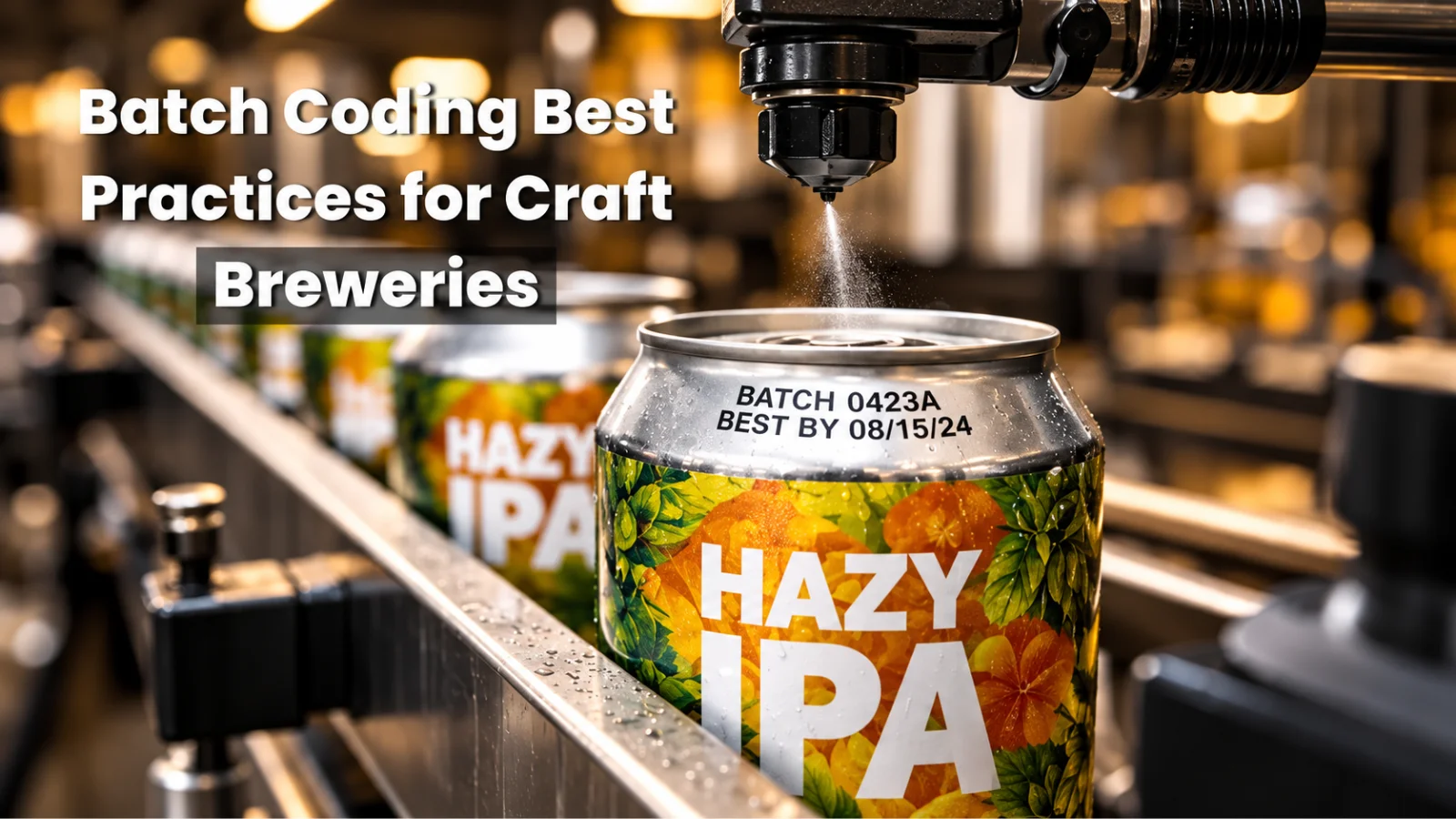
Batch coding assigns a unique identifier to every unit in a production run, enabling lot traceability in manufacturing and rapid product recall.
The code is printed directly onto the product or packaging, linking each physical unit to its production record: brew date, packaging line, shift, best-by date, and SKU. This practice forms the foundation of batch traceability — the ability to track and trace any unit back to the exact conditions under which it was produced.
For a craft brewery, this link is the difference between a contained quality event and an over-recall. If a defect surfaces in your distribution network and your batch codes are accurate, you pull only the affected run — not your entire inventory.
Key Terms Defined
Batch Code / Batch Number
A unique alphanumeric identifier assigned to all units produced in a single production run under the same conditions. In craft brewing, this typically encodes brew date, packaging line, and SKU.
Lot Number
Functionally identical to a batch number in brewing — a shared identifier for all units in one production run. The terms are interchangeable in craft beer operations.
Best-By Date
The consumer-facing freshness date printed on every unit. TTB requires this field to remain legible on every coded unit. Errors in best-by date coding are one of the most common craft brewery product recall triggers.
Serialization
A process assigning a unique code to every individual unit — standard in pharmaceuticals but not currently required for US craft beer. Lot-level batch coding is sufficient for regulatory compliance at most breweries today.
Batch Traceability
The documented ability to trace any unit from the retailer shelf back to its specific production batch, ingredients, processing conditions, and distribution path. Required for TTB, FSMA 204, and retail partner compliance.
Why Batch Coding Discipline Matters Now
Inconsistent batch coding causes immediate downstream losses: label reprints, changeover delays, compliance exposure, and over-recalls.
Craft breweries face tighter margins, rising food manufacturing traceability standards, and retailer mandates that are becoming conditions of shelf access rather than best practices. This guide gives brewery operators, quality leads, and production managers an execution-ready framework for building a controlled, repeatable batch coding system — one that protects margin, supports compliance, and scales as SKU complexity grows.
Where Breweries Lose Time and Money
Most batch coding waste accumulates through small process failures every shift — not single dramatic errors.
Common symptoms of a batch coding system that is out of control:
- Frequent label reprints from date code or data mismatches
- Elevated scrap from avoidable print or application defects
- Late-stage compliance corrections that disrupt production schedules
- Inconsistent shift-to-shift performance with no standard root-cause loop
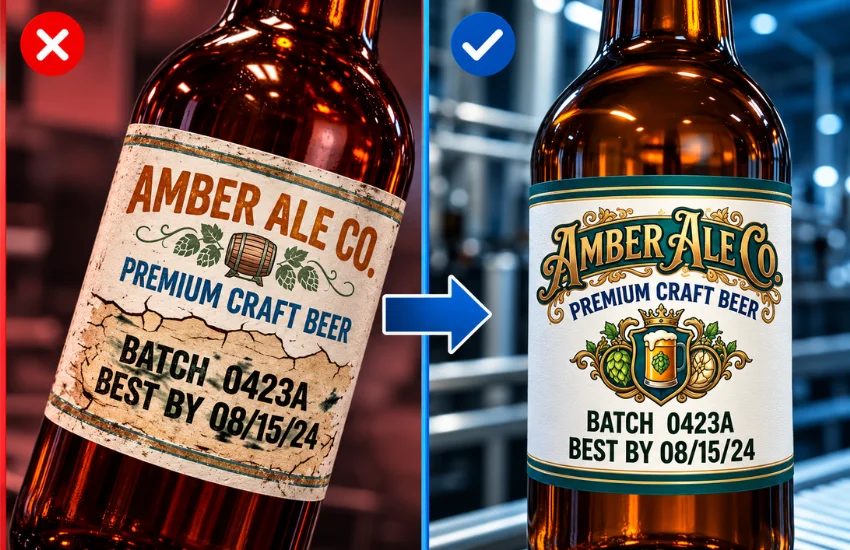
The Recall Reality: When a quality event occurs, the difference between a precise batch code and a missing or illegible one is the difference between pulling one production run and pulling everything in your distribution network. A well-executed batch traceability system does not just prevent errors — it limits the scope of what you have to act on when errors happen anyway. The tighter your lot-level traceability, the smaller and less costly your recall exposure.
Regulatory Requirements for US Craft Breweries
US craft brewery batch coding compliance is governed by TTB, FDA FSMA 204, and retailer-specific traceability food safety mandates.
Traceability food safety obligations and food manufacturing traceability standards are tightening across all beverage categories. The key frameworks:
Authority | Key Requirement | Scope | Record Retention |
TTB (Federal) | Mandatory label fields — brand, class, ABV, net contents, health warning — must remain legible on every coded unit | All interstate malt beverages | 3 years |
FDA / FSMA 204 | Lot-level Key Data Element recordkeeping at Critical Tracking Events: production, transformation, and shipping | FTL foods; scope expanding across food & beverage categories | 2 years minimum |
Retail / Distribution Partners | GS1-128 barcodes, best-by date coding, lot ID on case and unit — often a condition of shelf placement at national chains | National grocery chains and major specialty retailers | Partner-specific |
Lot traceability in manufacturing requires that production records linking each batch code to ingredients, processing conditions, and distribution be maintained for a minimum of two years. Digital records cross-referenced to your batch codes are the fastest path to compliance and the fastest path to a controlled product recall response.
Implementation Blueprint: A Structured 6-Step Rollout
A reliable batch coding system is a process redesign across six steps — not a single tool purchase.
Step 1: Establish Baseline Performance and Failure Taxonomy
Capture two to four weeks of defect data before changing any tool or workflow. Categorize every failure by root cause class: content mismatch, version control issue, setup error, print quality defect, application error, or final inspection miss. Build a scoreboard covering waste percentage, reprint count, rework hours, and defect recurrence. Effective lot tracking and traceability starts with baseline data that reveals exactly which failure class is costing you the most. Also measure FIFO discipline — whether older batches ship before newer ones. In craft beer, FIFO is a freshness commitment, not just an inventory principle.
Step 2: Standardize Data Inputs and Approval Gates
Create a governed intake model where every batch coding request confirms: the TTB-compliant label version, the correct best-by date calculated from the packaging date, the SKU validated against your current product list, and all required regulatory declarations for the target market. Enforce explicit gate checks before any print authorization — version locked, SKU mapping confirmed, date code formula verified.
Step 3: Harden Execution at the Line Level
Define a standard setup checklist per product family and shift: label version confirmation, date field verification, barcode scan check against GS1-128 Application Identifier standards, substrate confirmation for the specific packaging format running that shift, and first-article approval with a signed-off sample before the full run begins. A CIJ system printing on dry aluminum behaves differently than on refrigerated cans — substrate validation must be part of setup, not caught at final inspection.
Step 4: Implement Closed-Loop Exception Handling
Build a path where every exception is logged, triaged, assigned, and resolved with documented corrective action. Set service-level targets: high-severity issues must have containment within hours, root cause confirmed within one business day, and control updates implemented within a defined window.
Step 5: Track KPI Trends and Financial Impact
Maintain a weekly review cadence covering trend lines, top failure drivers, corrective action velocity, and economic impact. Connect batch coding KPIs directly to financial outcomes — avoided reprints, recovered labor hours, compliance incidents avoided.
Step 6: Scale with Governance and Training
Expand proven controls to adjacent lines, retrain teams, and conduct recurring audits. Document your highest-performing workflows and embed them in onboarding. Written controls and governance ensure improvements persist through staffing changes and peak-volume periods.
Batch Coding Technologies for Craft Brewery Lines
Packaging traceability depends on choosing the right coding technology for your substrate, line speed, and format.
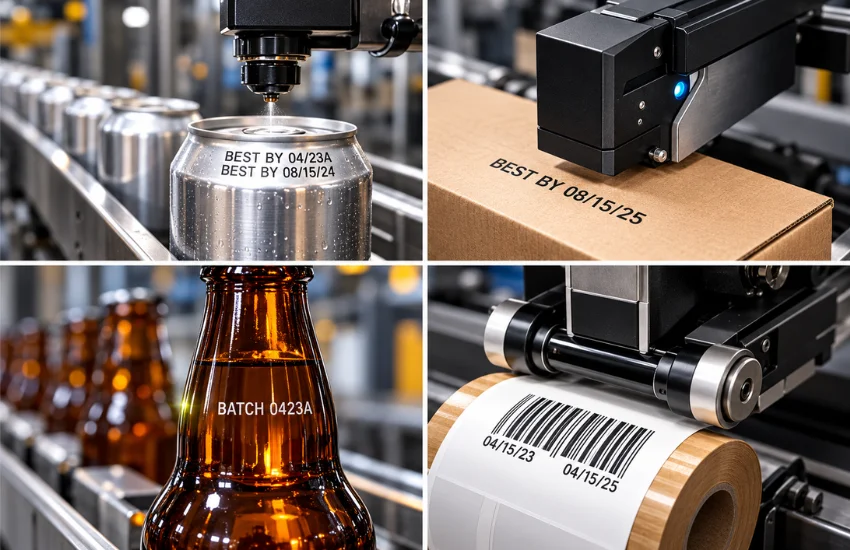
Four primary technologies serve the craft beverage market:
Continuous Inkjet (CIJ)
Non-contact technology ideal for high-speed canning and bottling lines running 300+ cans per minute. Prints on aluminum, glass, and plastic. Requires ongoing solvent and higher maintenance frequency than alternatives.
Thermal Inkjet (TIJ)
Low-maintenance, high-resolution printing on porous surfaces — cardboard cases and secondary packaging. No solvents required. Best for low-to-mid speed lines where print precision is prioritized over throughput volume.
Laser Coding
Etches permanent, smudge-proof marks directly into the substrate with no consumables. Laser coding is ideal for glass bottles and pre-applied label surfaces, and produces codes that withstand refrigeration and handling. Higher capital cost; lower total cost of ownership over time.
Thermal Transfer Overprinting (TTO)
Transfers ink from a ribbon onto flexible packaging or pressure-sensitive label stock using heat. Standard for label printers applying variable data — batch number, best-by date, and SKU — to label rolls at mid-speed.
Technology | Best For | Speed | Consumables | Common Brewery Use |
CIJ | Cans, glass, plastic | High-speed 300+ cpm | Ink + solvent | Primary canning / bottling line |
TIJ | Cases, cartons, secondary packaging | Low-to-mid speed | Replaceable cartridge | Secondary / case coding |
Laser Coding | Glass, label surfaces | High-speed capable | None — consumable-free | Permanent bottle and label coding |
TTO | Labels, flexible film | Mid-speed | Ribbon | Variable data on label stock |
The modern direction for multi-SKU craft operations is inline digital overprinting — printing batch number, best-by date, barcode, and SKU directly onto label stock in a single pass, eliminating the version control gap between label application and code application where most failures occur. Whether your line runs CIJ, laser coding, TIJ, or TTO, Arrow Systems’ ArrowJet platforms are built for high-changeover, short-run brewery production environments.
KPI Framework: What to Measure Weekly
Track seven batch coding KPIs as a portfolio — one metric in isolation is easy to game and easy to misread.
# | KPI | What It Measures | Why It Matters for Craft Breweries |
1 | Label Waste Rate (%) | Material waste tied to coding and label defects | Top-line cost signal for the system |
2 | Reprint Frequency | Count and trend of repeat runs by root cause | Reveals which failure class is recurring |
3 | Rework Labor Hours | Hours correcting batch code or label issues | Converts quality failures to a labor cost |
4 | First-Pass Yield | Runs clearing first-article checks without correction | Direct measure of setup discipline |
5 | Date Code Accuracy Rate | Units with correct, legible best-by and batch codes | Wrong dates are a product recall and TTB compliance risk |
6 | Compliance Incident Count | Deviations involving required label declarations | Early warning for regulatory exposure |
7 | Corrective Action Cycle Time | Days from incident logged to verified closure | Measures whether the exception loop is actually closing |
Common Pitfalls and How to Avoid Them
Five patterns cause most batch coding improvement initiatives to stall or regress within 90 days.
- Tool-first decisions without process clarity. Buying capability before defining standards increases complexity. Start with process controls, then align tooling.
- Missing ownership at approval gates. If accountability is shared by everyone, it is owned by no one. Assign explicit owners and named alternates for every gate checkpoint.
- Weak change communication. Late artwork or date code updates reaching the line without a clear notification path create avoidable errors. Enforce version confirmation before every run.
- Training drift. New operators trained below standard introduce variability that surfaces weeks later as unexplained quality events. Embed batch coding controls in every onboarding sequence.
- Reporting activity instead of outcomes. Counting checklists completed is not measuring improvement. Every review must answer: is waste lower than last month? Are date code accuracy rates improving?
Frequently Asked Questions — Batch Coding for Craft Breweries
Answers to the most common questions from craft brewery operators evaluating batch coding improvements.
How do craft breweries manage changeovers without risking a mislabel when running 4–6 SKUs per week?
Lock each SKU’s label version and date code parameters as a validated file rather than entering them manually per run. Require a signed-off first-article sample before each changeover completes. Inline digital overprint systems that store and recall SKU profiles automatically eliminate most of the mislabel risk in high-changeover environments.
Who owns label compliance when a craft brewery's canning line is run by a co-packer?
The brewery owns regulatory compliance regardless of who operates the equipment. A TTB violation or a wrong best-by date is the brewery’s liability. The approval gate process must include explicit verification of every coded field before release, and the co-packer agreement should define corrective action ownership in writing.
How long until a craft brewery sees measurable results from improving batch coding practices?
Most breweries see early movement in waste and reprint frequency within two to six weeks when baseline metrics are accurate and gate controls are enforced consistently. Larger gains in date code accuracy and compliance incident counts typically appear in weeks four through eight as corrective actions start closing recurring failure classes.
30-60-90 Day Execution Plan
Sequence the rollout in three phases to build early wins before scaling across all lines.
Phase | Focus | Key Actions | Success Signal |
Days 1–30 | Baseline and pilot line control | Capture all 7 KPIs. Standardize data inputs and first-article checklist on one pilot line. Start exception log. | Baseline complete. Pilot line running standard checklist. Exception log active. |
Days 31–60 | Exception loop and KPI governance | Launch weekly KPI reviews. Strengthen closed-loop exception handling. Add GS1 barcode validation. Target top two failure classes. | Weekly cadence established. Exception cycle time trending down. Top failures in active corrective action. |
Days 61–90 | Scale and governance | Expand controls to all lines. Update onboarding documentation. Conduct first governance audit. | Controls replicated across lines. Measurable waste and reprint reduction vs. baseline. |
Next Step for Brewery Leadership
Start with a focused 30-day pilot on your highest-impact line — the one with the most frequent changeovers, highest label waste rate, or greatest compliance exposure. Measure against your baseline. At the end of 30 days you will have real data showing exactly where the ROI is and what to scale.
Arrow Systems’ ArrowJet inline digital print and finishing platforms are built for high-changeover, short-run brewery production. Contact our team for a batch coding assessment tailored to your line configuration and SKU profile.
Pet Food Brand Label Supplier Problems: 5 Signs to Print In-House
Table of Contents Pet Food Brand Label Supplier Problems: 5 Signs to Print In-House Most pet food label supplier problems are a model mismatch: flexo’s

Coffee Roaster Flexible Pouch Printing Workflow: Roll to Bag
Table of Contents Coffee Roaster Flexible Pouch Printing Workflow: Roll to Bag In-house coffee pouch printing runs five stages — substrate loading, queue setup, the

Overlaminate vs. Varnish Labels: How to Choose Protection
Table of Contents Overlaminate vs. Varnish Labels: How to Choose Protection Film overlaminate protects against immersion, wash-down, and solvents; UV and aqueous varnish suit retail
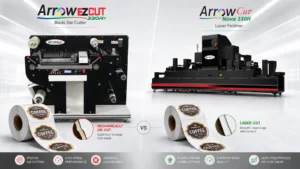
Blade vs. Laser Label Die Cutting: Accuracy, Speed, and Cost per Label
Table of Contents Blade vs. Laser Label Die Cutting: Accuracy, Speed, and Cost per Label Blade die-cutting suits simple shapes and long runs; CO2 laser
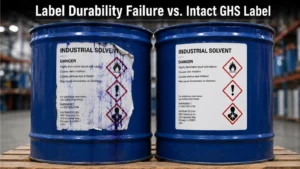
GHS Label Durability Failure: 4 Causes and Practical Fixes
Table of Contents GHS Label Durability Failure: 4 Causes and Practical Fixes GHS label durability failures trace to four causes: aqueous ink chemistry, paper face

White Ink Clear Label Printing: When You Need It and Why
Table of Contents White Ink Clear Label Printing: When You Need It and Why White ink under clear film keeps brand color, mandatory copy, and