Table of Contents

Sachet packaging

The Minimum Order Problem: Why Small Brands Cannot Access Professional Sachet Packaging (And How Digital Changes Everything)

Introduction

You have a great product. Maybe it is a powdered greens supplement, a specialty tea blend, or a revolutionary electrolyte drink mix. You have got the formula perfected, the branding designed, and early customers who love it.

But then you hit the packaging wall.

Our minimum order is 50,000 units.

We need 100,000 sachets to justify the plate setup.

Short runs are not cost-effective with Rotogravure.

This is the minimum order problem, and it is killing small brands before they get started. But just like with custom tape, digital printing is rewriting the rules for sachet packaging.

The Economics of Traditional Sachet Printing

Why Rotogravure and Flexographic Require Massive MOQs

Traditional sachet printing methods were designed for massive CPG brands shipping millions of units. Here is why they cannot serve small brands:

Rotogravure Printing:

  • Cylinder engraving: ,000–15,000 per design

  • Setup time: 4–8 hours of press time

  • Minimum efficient run: 100,000+ sachets

  • Per-unit cost at small volumes: Prohibitively expensive

Flexographic Printing:

  • Plate costs: 00–2,000 per color

  • Setup waste: 1,000–5,000 sachets

  • Minimum order: 25,000–50,000 sachets

  • Color limitations: Additional costs for each color

The math is brutal: If you are a startup selling 500 units per month, a 50,000-unit minimum is an 8-year supply.

The Real Cost of High Minimums

Cash Flow Crisis

That 50,000-unit order? It might cost 5,000–25,000 upfront. For early-stage companies, that is:

  • Months of operating capital

  • Marketing budget that could acquire customers

  • Product development funds for line extensions

Inventory Risk

What if your design is not perfect?

  • Typo in the supplement facts

  • Regulatory compliance issue

  • Rebranding six months in

  • New competitor forces differentiation

With a 50,000-unit minimum, you are stuck with outdated inventory or eating the cost.

Storage Nightmares

50,000 sachets take up serious warehouse space:

  • Climate-controlled storage (humidity affects product quality)

  • Inventory management systems

  • Insurance and security

  • Potential for damage or expiration

Opportunity Cost

Capital tied up in sachet inventory cannot be used for:

  • Marketing and customer acquisition

  • Product development

  • Team expansion

  • Market expansion

The Digital Printing Revolution for Sachets

How Digital Changes the Economics

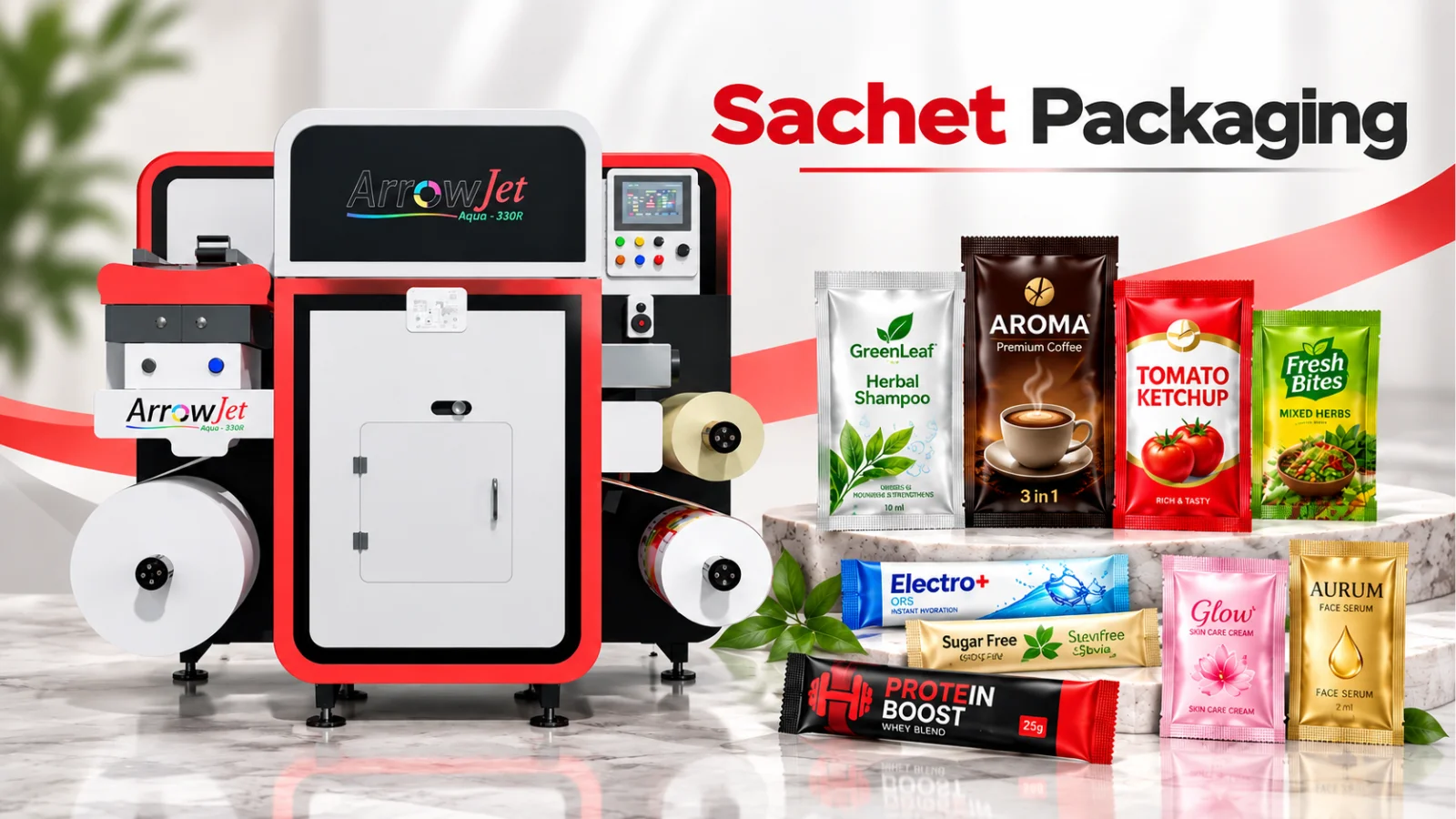
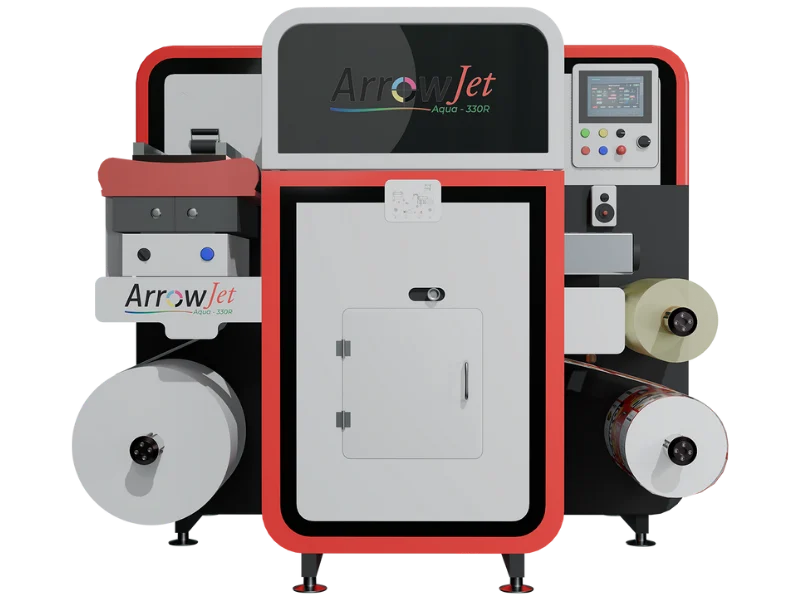
The ArrowJet Aqua 330R Lite uses single-pass digital inkjet technology to print directly onto flexible sachet substrates. This eliminates the fixed costs that create minimum order requirements.

ArrowJet Aqua 330R Lite

Digital printing economics:

  • Setup costs: sh

  • Plate/cylinder costs: sh

  • Setup waste: Minimal (10–50 sachets)

  • Minimum order: 100 sachets (or even less)

The New Math

Order SizeTraditional RotogravureDigital (ArrowJet)
500 sachets-12 per unit (with setup)sh.50–1.00 per unit
5,000 sachets-4 per unitsh.30–0.60 per unit
25,000 sachetssh.80–1.50 per unitsh.20–0.40 per unit
100,000 sachetssh.30–0.60 per unitsh.15–0.30 per unit

Note: Pricing varies by specifications and substrate. Digital becomes cost-competitive at lower volumes.

Real-World Scenarios: Small Brands Winning with Digital

Scenario 1: The Supplement Startup

Profile: New collagen powder brand, launching with 3 flavors, expecting 200 orders/month

Traditional approach:

  • Order 50,000 sachets per flavor (150,000 total)

  • Cost: 5,000–75,000 upfront

  • Risk: If one flavor flops, stuck with useless inventory

Digital approach:

  • Order 1,000 sachets per flavor to start

  • Cost: ,500–3,000

  • Flexibility: Adjust flavor mix based on sales data

Result: Launched with 95% less capital, iterated based on customer feedback, doubled down on best-selling flavor.

Scenario 2: The Beverage Innovator

Profile: Electrolyte drink mix, direct-to-consumer model, testing 5 different formulations

Traditional approach:

  • Cannot afford 5 separate 50,000-unit orders

  • Forced to pick one winner without market testing

  • High risk if chosen formulation underperforms

Digital approach:

  • Print 500 sachets of each formulation

  • Send samples to 2,500 potential customers

  • Collect feedback and iterate

  • Scale the winning formula

Result: Data-driven product selection, 60% higher customer satisfaction vs. best guess approach.

Scenario 3: The Tea Blender

Profile: Artisan tea company, 12 seasonal blends, small batch ethos

Traditional approach:

  • Minimums make small-batch branding impossible

  • Forced into commodity packaging or massive inventory

  • Seasonal variations economically unviable

Digital approach:

  • Print 2,000 sachets per seasonal blend

  • 12 unique designs, no plate costs

  • Align packaging with harvest seasons

Result: Authentic small-batch positioning, 40% premium pricing vs. commodity tea, zero obsolete inventory.

The ArrowJet Aqua 330R Lite for Sachet Production

Technical Capabilities

  • Print width: Up to 13 inches

  • Resolution: Up to 1600 × 1600 dpi

  • Inks: Aqueous pigment (food-safe options available)

  • Speed: Production rates suitable for commercial short runs

  • Substrate compatibility: PET/PE, foil laminates, paper-based materials, biodegradable films

Conclusion: Access Without Compromise

Small brands no longer need to choose between professional packaging and affordability, quality and flexibility, or short runs and good unit economics.

Digital printing with the ArrowJet Aqua 330R Lite removes the barriers that kept small brands from accessing professional sachet packaging.

Contact With Our Team Now