Cosmetic Label Printing: FDA Requirements for Beauty Brands
Table of Contents Cosmetic Label Printing: FDA Requirements for Beauty Brands U.S. cosmetic labels must satisfy 21 CFR Part 701, the FPLA, and MoCRA 2022

The beauty industry has fundamentally shifted. Heritage brands with decades of history now compete against agile newcomers, influencer-launched lines, and retailer house brands. This democratization has created explosive demand for contract manufacturing and white-label beauty products.
Today’s contract manufacturers serve diverse clients: indie founders testing concepts, social media influencers monetizing audiences, spas creating proprietary skincare lines, and retailers developing exclusive house brands. Each needs professional products. Each needs custom-branded labels. And each needs them produced rapidly, flexibly, and affordably.
But here’s the operational challenge: every client demands unique customization. Different brand identities. Distinct packaging designs. Varying product SKUs. Market-specific regulatory requirements. Traditional label printing—with rigid setup fees, high minimum orders, and lengthy lead times—struggles to profitably serve this fragmented, fast-moving market.
This guide explores how contract manufacturers can solve the white-label labeling challenge using modern variable data digital printing—converting what was once a production bottleneck into a genuine competitive advantage.
A typical beauty contract manufacturer might simultaneously support:
The mathematics become daunting quickly: 30 clients × 10 SKUs each = 300 unique label designs. Each design historically required separate print runs, individual inventory management, and careful version control.
Setup Economics:
Volume Requirements:
Production Timelines:
Version Control Complexity:
Variable Data Printing (VDP) enables production of unique information on each label using database-driven content. While conventional printing produces identical copies, VDP generates individualized labels at full production speeds.
For white-label beauty manufacturing:

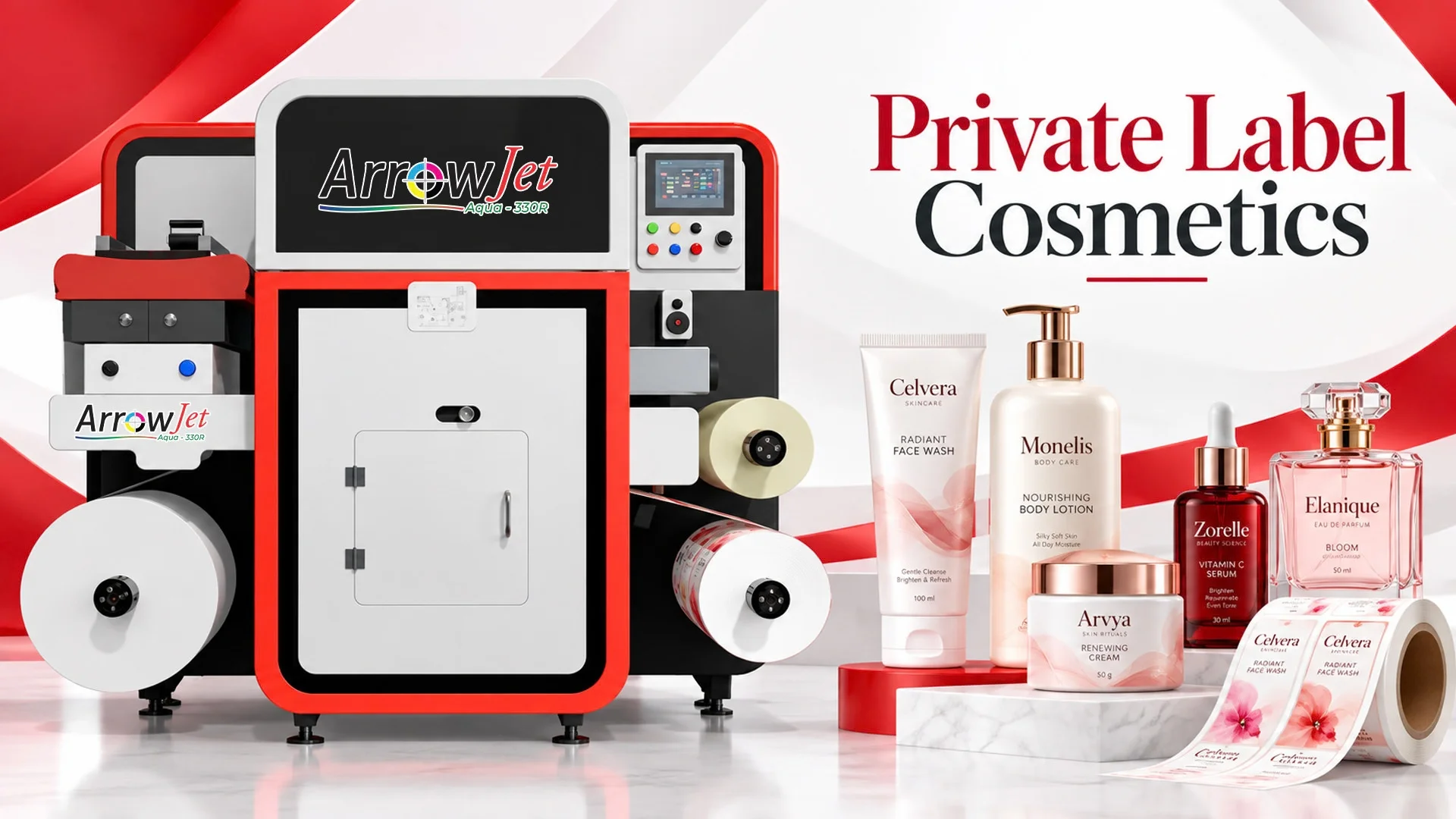
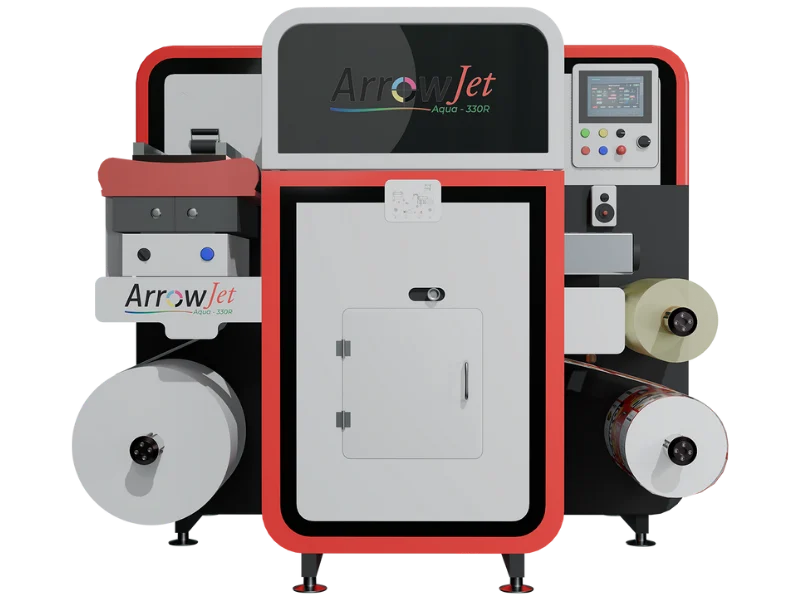
This production-grade variable data printer addresses the specific needs of high-changeover manufacturing environments:
Direct CSV Integration: Import client data straight from spreadsheets without middleware. Simple column mapping connects brand assets to template fields in minutes.
Regulatory-Grade Resolution: 1600×1600 dpi produces crisp, compliant ingredient lists with exceptional small-text legibility for FDA-required disclosures.
Dynamic Graphics Capability: Swap logos, brand colors, and product imagery automatically between clients. Different substrates and finishes per SKU without manual intervention.
Production Speed: Full variable data processing without per-label delays—maintain fulfillment velocity even with high customization.
Cost-Efficient Operation: Water-based pigment inks deliver lower cost-per-label than alternatives with a natural matte finish preferred by premium beauty brands.
Client onboarding required 3-4 weeks minimum: brand asset collection (1-2 days), label design (2-3 days), client approval cycles (3-5 days), printer submission (1 day), production waiting (10-14 days), plus receiving and warehousing (2-3 days).
Ongoing management meant warehousing label inventory for dozens of clients, tracking version control manually, managing expiration and obsolescence, and processing reorders on 2-3 week cycles.
Annual operational costs reached $110,000-$170,000: $50,000-$75,000 in setup fees, $25,000-$40,000 in obsolete inventory write-offs, $15,000-$25,000 in rush fees, plus $20,000-$30,000 in warehousing expenses.
Client onboarding compresses to 2-3 days: rapid asset collection, data template population in hours, same-day sample printing, and immediate production upon approval.
Inventory management becomes nearly zero—labels print on-demand as orders arrive. Version control lives digitally. Reorders fulfill same-day. Warehouse space requirements drop dramatically.
Annual costs fall to $15,000-$25,000: minimal operating expenses, zero setup fees, and virtually no obsolete inventory liability.
Net annual savings: $95,000-$145,000
Phase 1: Template Development (Weeks 1-2)
Analyze existing label portfolio to identify common structures. Design 3-5 master template variations with built-in compliance frameworks.
Phase 2: Data Infrastructure (Weeks 3-4)
Create standardized client data collection forms and spreadsheet templates. Establish validation procedures ensuring regulatory compliance.
Phase 3: Equipment Integration (Weeks 5-6)
Install and configure variable data printing systems. Train operations staff and validate production quality with existing clients.
Phase 4: Pilot Migration (Weeks 7-8)
Transition 5-10 current clients to the new workflow. Run parallel operations, measure results, and gather client feedback.
Phase 5: Full Deployment (Weeks 9-12)
Migrate entire client base to digital printing. Optimize workflows, market enhanced capabilities, and document ROI achievements.
White-label beauty manufacturing represents a significant growth opportunity, but traditional label production creates operational friction that constrains success. Setup fees, volume minimums, and extended timelines force contract manufacturers into difficult compromises that limit client relationships.
Variable data digital printing with the ArrowJet Aqua 330R offers a superior alternative. By transforming label production from a rigid, SKU-by-SKU process into a flexible, data-driven system, contract manufacturers can serve more beauty brands with greater agility at reduced operational cost.
The transformation extends beyond efficiency metrics to genuine business advantage: faster client acquisition, minimal inventory burden, superior client satisfaction, and meaningful competitive differentiation. In private label cosmetics, operational speed and production flexibility aren’t operational luxuries—they’re the foundation of sustainable growth.
Ready to transform your contract manufacturing operation? Contact Arrow Systems for a free private label printing consultation.

Table of Contents Cosmetic Label Printing: FDA Requirements for Beauty Brands U.S. cosmetic labels must satisfy 21 CFR Part 701, the FPLA, and MoCRA 2022

Table of Contents Flexible Pet Packaging: Digital Printing for Pouches and Bags Flexible pet packaging — stand-up pouches and flat-bottom bags — is now the

Table of Contents GMP Label Printing for Supplements: A Manufacturer’s Guide to 21 CFR Part 111 GMP label printing for supplements means producing every bottle

Table of Contents Cannabis Gummy Packaging: Labels, Flexible Pouches, and State Compliance — A 2026 Brand Guide Cannabis gummy packaging must meet child-resistant standards, opaque-material

Table of Contents AAFCO Pet Food Label Requirements: 2026 Brand Guide AAFCO pet food label requirements define eight mandatory elements every dog and cat food

Table of Contents Vitamin Bottle Labels: Materials, Inks, and Compliance Guide HDPE supplement bottles require substrate, adhesive, ink, and workflow decisions that are compliance decisions