Cosmetic Label Printing: FDA Requirements for Beauty Brands
Table of Contents Cosmetic Label Printing: FDA Requirements for Beauty Brands U.S. cosmetic labels must satisfy 21 CFR Part 701, the FPLA, and MoCRA 2022

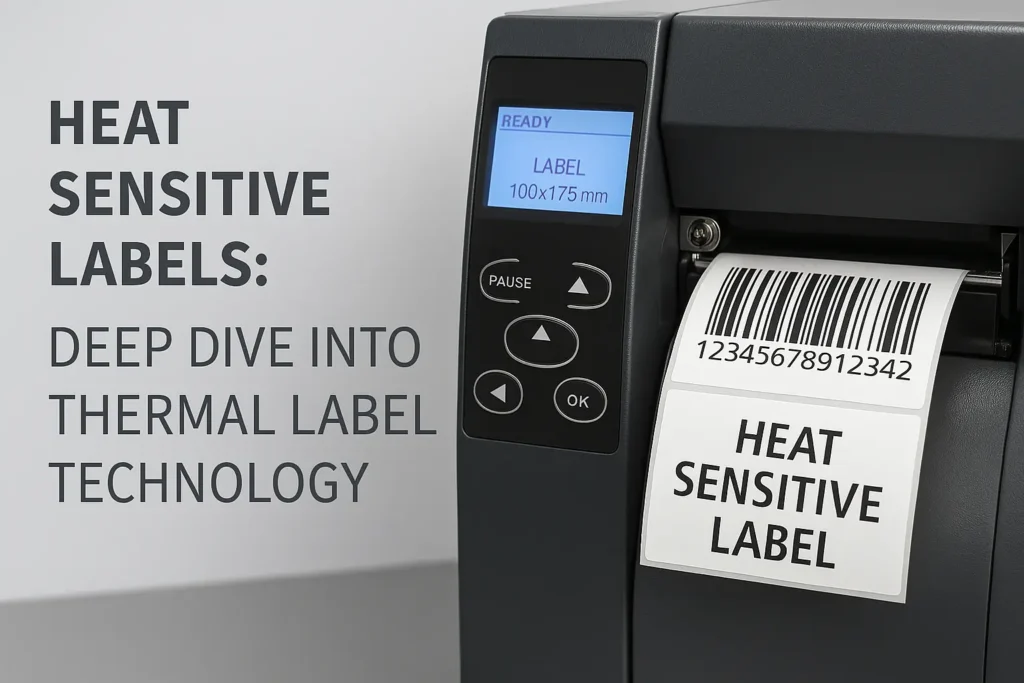
If you’ve landed here, you’re likely curious about heat‑sensitive labels—what they are, how they work, their uses, limitations, and everything in between. Let’s unpack the full story.
Heat-sensitive labels (sometimes called thermal labels) rely on coated materials that change color when exposed to heat—no ink or toner needed. There are two primary technologies:
Technically speaking, direct Thermal labels rely on leuco dye chemistry—typically microencapsulated dyes that darken when heated above a specific threshold.
Direct thermal labels use several components in their imaging layer: leuco dyes, developers, sensitizers, and stabilizers. When heat is applied, leuco dyes react with developers in a microcapsule and turn black. Sensitizers lower the activation temperature (~100 °C), and stabilizers help preserve the image.
In thermal transfer labels, printing occurs by melting ribbon-based ink which adheres to the label surface. The ribbon type determines durability—wax for everyday use, wax‑resin for a balance, pure resin for maximum resistance.
Beyond printing-based thermal labels, thermochromic labels incorporate temperature‑sensitive inks that change visible color (beyond black) at defined thresholds—often used as indicators or in smart packaging.
These inks are sensitive to UV, abrasion, humidity, solvents—their color-changing performance degrades over time or under rough handling.
Scenario | Recommended Label |
Printing shipping labels, tickets, receipts (≤ 6 mo) | Direct Thermal |
Asset tags, outdoor labels, medical and safety use | Thermal Transfer |
Temperature-indicating labels or interactive packaging | Thermochromic (ink-based) |
Key factors to consider:
Heat-sensitive labels encompass both direct thermal printing, thermal transfer printing, and thermochromic ink-based labels. Each has distinct chemistry, visual behavior, and operational tradeoffs. Your decision hinges on expected lifespan, exposure environment, cost constraints, and whether interactivity or smart indicators are required.

Table of Contents Cosmetic Label Printing: FDA Requirements for Beauty Brands U.S. cosmetic labels must satisfy 21 CFR Part 701, the FPLA, and MoCRA 2022

Table of Contents Flexible Pet Packaging: Digital Printing for Pouches and Bags Flexible pet packaging — stand-up pouches and flat-bottom bags — is now the

Table of Contents GMP Label Printing for Supplements: A Manufacturer’s Guide to 21 CFR Part 111 GMP label printing for supplements means producing every bottle

Table of Contents Cannabis Gummy Packaging: Labels, Flexible Pouches, and State Compliance — A 2026 Brand Guide Cannabis gummy packaging must meet child-resistant standards, opaque-material

Table of Contents AAFCO Pet Food Label Requirements: 2026 Brand Guide AAFCO pet food label requirements define eight mandatory elements every dog and cat food

Table of Contents Vitamin Bottle Labels: Materials, Inks, and Compliance Guide HDPE supplement bottles require substrate, adhesive, ink, and workflow decisions that are compliance decisions