
Pet Food Brand Label Supplier Problems: 5 Signs to Print In-House
Table of Contents Pet Food Brand Label Supplier Problems: 5 Signs to Print In-House Most pet food label supplier problems are a model mismatch: flexo’s


Energy efficiency in label printing operations means producing the same output with less energy, less waste, and fewer avoidable interruptions — and it starts with understanding where your facility’s energy is actually going.
Label printing facilities consume energy across production equipment, HVAC, lighting, compressed air, and support devices — reducing that demand lowers utility costs, cuts emissions, and reduces pressure during peak-rate periods.
Energy efficiency is a broad sustainability in printing initiative because both large and small changes can produce meaningful results across all three parts of the triple bottom line: people, planet, and profit. For a label printing operation, the practical entry point is reduction — getting the same amount of sellable work done using less energy input.
A realistic energy inventory for a label printing facility includes:
Production equipment
Digital and conventional label presses, finishing lines, slitters, and laminators draw power throughout every shift — and continue drawing standby power when idle. Production equipment is typically the largest single energy consumer in the facility.
Compressed air systems
Many conventional finishing systems and older press platforms require a continuous supply of compressed air. Air compressors run to maintain line pressure whether or not equipment is actively printing, and leaks in the distribution system waste a significant share of that output. Compressed air is consistently one of the highest energy costs in manufacturing environments.
HVAC and climate control
Label printing requires controlled temperature and humidity for consistent ink adhesion and substrate behavior. HVAC systems run continuously and often represent a significant portion of a facility’s total utility bill — particularly in facilities where environmental controls must stay within tight tolerances.
Lighting
Production floors, inspection areas, warehouses, and offices all consume lighting energy. Older fluorescent and incandescent installations draw more power and generate more heat than modern LED alternatives, compounding both the lighting load and the HVAC load required to offset that heat.
Office and support devices
Computers, monitors, printers, kitchen appliances, and idle chargers draw continuous low-level power. Individually small, these loads accumulate across a full shift and continue outside working hours when devices are not actively shut down.
When a facility reduces its energy demand across these systems, the benefits compound: lower utility costs reduce operating overhead, lower emissions reduce environmental impact, and lower peak demand reduces exposure to time-of-use rate spikes on utility bills.
An energy audit establishes the baseline without which prioritization and progress tracking are guesswork — it identifies the largest consumers and the most accessible reduction opportunities before any spending begins.
Before targeting specific improvements, a facility needs to understand where energy is actually going. An audit should cover every area, not only the obvious production equipment:
A facility can hire an external energy auditor or use internal resources alongside publicly available guidance. The US Department of Energy and the EPA both publish energy management frameworks for manufacturing operations. The EPA’s Energy Star program runs a dedicated printing industry partnership called Printing Focus, which provides resources specifically for print facilities.
The governing principle is straightforward: measure before you prioritize. Without a baseline, it is impossible to know which changes will produce the greatest impact, or to demonstrate progress over time to leadership or customers.
Misprints, jams, repeated setups, and unplanned downtime force equipment to run longer than necessary — eliminating that waste reduces both ink and material costs and energy consumption at the same time.
Energy efficiency in label printing is not only about light bulbs or HVAC settings. It extends directly into the production process. Every time a press runs an avoidable job — correcting a mismatch, re-running a registration error, or clearing a jam caused by a substrate loaded incorrectly — it consumes energy without producing billable output. The cumulative effect across shifts and weeks is material.
Job planning and scheduling
Grouping similar substrates and ink sets reduces changeover time and the energy drawn during repeated setup sequences. Scheduling longer runs during off-peak utility rate periods can also reduce demand charges for facilities on time-of-use billing structures.
Preventive maintenance routines
Printhead cleaning cycles, nip roller inspection, and dryer calibration prevent the types of failures that cause mid-run stops and re-runs. A press operating under a structured maintenance program produces more sellable output per kilowatt-hour than one running with deferred maintenance.
Operator training
Operators who understand how to prepare substrates correctly, set media tension accurately, and respond early to quality signals generate fewer misprints per shift than untrained staff on equivalent equipment. Training is one of the lowest-cost, highest-return energy efficiency investments available.
Quality inspection checkpoints
Catching a color or registration issue at the 50-label mark costs far less energy than discovering it at roll completion. Inline inspection systems — or structured spot-check routines at defined intervals — reduce the energy cost of quality failures before they reach full-run scale.
An energy management program converts audit findings into goals with named owners — without this structure, improvements happen once and stop rather than compounding over time.
Once a facility has completed its audit and identified its primary energy consumers, the next step is turning that knowledge into structured action. The most effective programs share several common characteristics:
Participation from the full facility is critical. Many of the most actionable opportunities are visible only to the people closest to daily operations — press operators, maintenance staff, and shift leads. A program that reaches from production to the front office surfaces more ideas and follows through more consistently than one managed exclusively by leadership reviewing monthly utility bills.
Energy efficiency improvements range from zero-cost behavioral changes to capital infrastructure investments — both deliver real results when matched to facility audit findings and operational priorities.
|
Level |
Examples |
Typical Investment |
|
Behavioral / no-cost |
Turn off unused lights; unplug idle devices and chargers; eliminate personal space heaters; enforce equipment standby shutdowns at shift end |
None |
|
Low-cost retrofits |
LED bulb replacements; motion sensors in restrooms and storage areas; daylight sensors on exterior fixtures; faucet aerators and low-flow plumbing fixtures |
Low — short payback period |
|
Mid-range upgrades |
Full production floor LED retrofit; HVAC tune-up and zone control; compressed air leak detection and repair program; building insulation improvements |
Moderate — evaluate against projected utility savings |
|
Major infrastructure |
HVAC system replacement with high-efficiency units; Energy Star-rated appliances facility-wide; building envelope improvements; renewable energy feasibility assessment |
Capital investment — requires formal ROI analysis |
The practical approach is to act on the no-cost and low-cost tiers immediately — these create quick savings and demonstrate organizational commitment — then use the energy audit baseline to build a business case for mid-range and major upgrades over a defined planning horizon.
Financial support is available at multiple levels. State and local governments, utility companies, and federal programs — including the EPA’s Energy Star Printing Focus partnership — offer incentives and technical assistance for qualifying print facilities. The US Department of Energy is an additional resource for facilities pursuing larger energy reduction commitments.
Press and equipment selection is an energy decision that affects the facility’s baseline load for the operational life of the machine — infrastructure requirements and auxiliary systems deserve the same scrutiny as print speed and resolution during any equipment review.
When evaluating or replacing label printing equipment, energy consumption characteristics deserve the same scrutiny as print speed and resolution. Key questions to raise during any equipment review include:
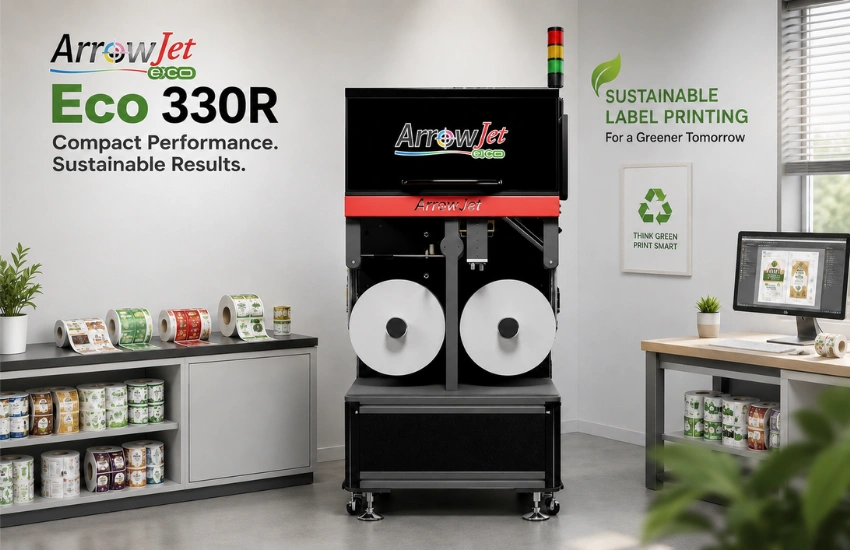
As a reference point for how equipment design affects operational energy load: the ArrowJet Eco 330R is a compact digital label press designed to operate on single-phase power with no air compressor required — a design that eliminates the compressor entirely as an energy consumer.
Equipment-level decisions compound over time. A press that reduces infrastructure demands and auxiliary system requirements contributes to lower facility energy consumption across every shift it runs. Explore Arrow’s range of digital label printers to review specifications and assess how equipment choices align with your facility’s energy and operational goals.
Arrow Systems manufactures digital label presses designed for straightforward installation and lower infrastructure overhead. Request a sample to assess print quality before you commit — or contact the Arrow team to discuss which press fits your production requirements.
The first step is to conduct an energy audit. Auditing your facility identifies the largest energy consumers — production equipment, HVAC, lighting, and compressed air systems — and shows you where reductions will have the greatest impact before any money is spent on upgrades.
Yes. Every mismatch, jam, or repeated setup run means your equipment is running longer to produce the same number of sellable labels. Reducing misprints and rework directly reduces equipment runtime and therefore energy use.
Compressed air systems are among the largest energy consumers in a manufacturing facility. Air compressors run continuously to maintain pressure, and leaks in the line waste a significant portion of that energy. Presses that do not require an air compressor eliminate this load entirely.
Common upgrades include switching to LED lighting, installing motion sensors and daylight sensors, improving HVAC efficiency, adding building insulation, and replacing older appliances with Energy Star-rated equipment. Larger investments typically deliver longer-term savings but require budget planning and ROI assessment before committing capital.
Many of the most actionable energy-saving opportunities are discovered by the people closest to daily production — press operators, maintenance staff, and department leads. A facility-wide program creates accountability, surfaces ideas that management may not see, and makes energy goals a shared operational metric rather than a compliance exercise.
Table of Contents Pet Food Brand Label Supplier Problems: 5 Signs to Print In-House Most pet food label supplier problems are a model mismatch: flexo’s

Table of Contents Coffee Roaster Flexible Pouch Printing Workflow: Roll to Bag In-house coffee pouch printing runs five stages — substrate loading, queue setup, the

Table of Contents Overlaminate vs. Varnish Labels: How to Choose Protection Film overlaminate protects against immersion, wash-down, and solvents; UV and aqueous varnish suit retail
Table of Contents Blade vs. Laser Label Die Cutting: Accuracy, Speed, and Cost per Label Blade die-cutting suits simple shapes and long runs; CO2 laser
Table of Contents GHS Label Durability Failure: 4 Causes and Practical Fixes GHS label durability failures trace to four causes: aqueous ink chemistry, paper face
Table of Contents White Ink Clear Label Printing: When You Need It and Why White ink under clear film keeps brand color, mandatory copy, and