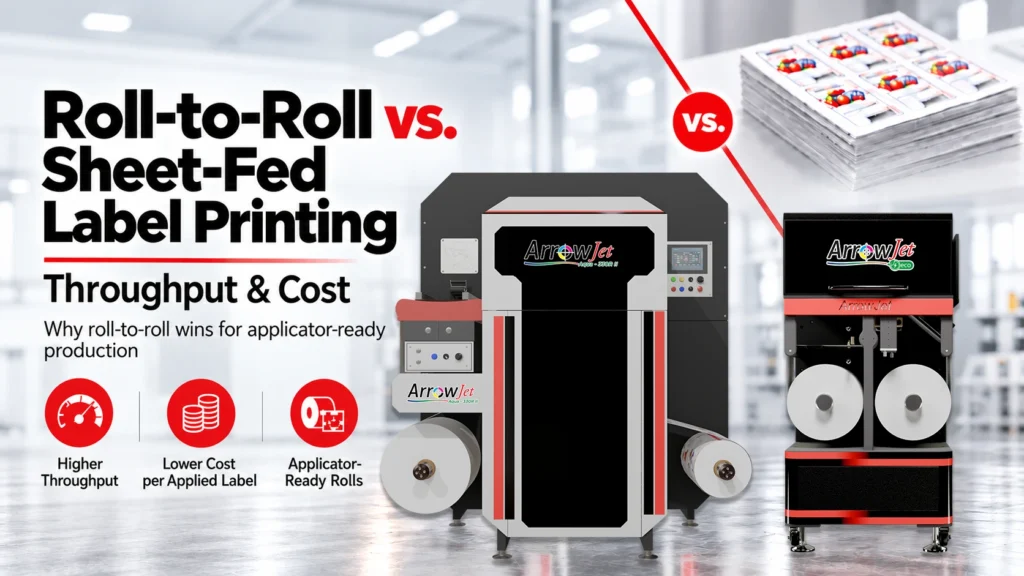
Roll-to-Roll vs. Sheet-Fed Label Printing: Throughput & Cost
Table of Contents Roll-to-Roll vs. Sheet-Fed Label Printing: Throughput & Cost Rolls win on cost per applied label with an automatic applicator; sheets win on

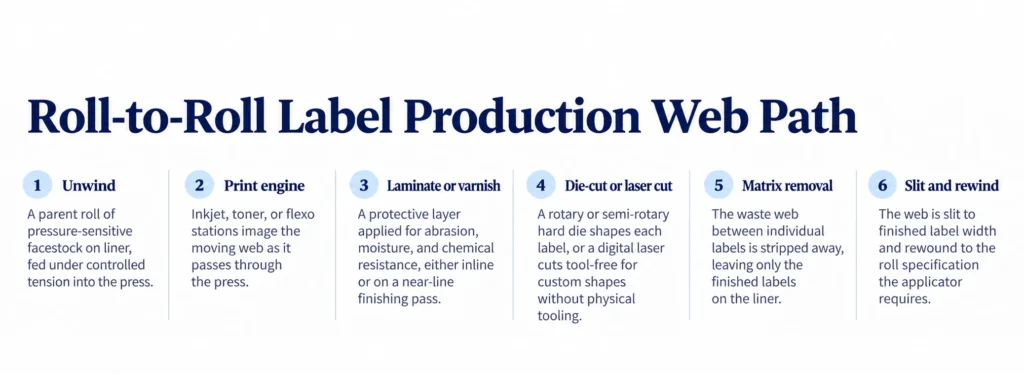
A roll-to-roll press images a continuous web under tension, then finishes it inline or near-line into applicator-ready rolls.
A roll-to-roll label press treats label stock as a continuous web. Material unwinds from a parent roll of pressure-sensitive facestock under controlled tension, passes the print engine, then moves into finishing — either inline on the same pass or near-line on a separate finishing unit.
Sheet-fed production images individual sheets with multiple labels imposed per sheet, then finishes and hand-applies them off the press.
Automatic applicators require a continuous web, so sheet-fed output nearly always means labor-bound hand application in production.
This is the part most format comparisons skip, and it is usually the deciding factor.
Print and apply label applicators pull a liner web across a peel plate at controlled speed, use a gap sensor to index each label, and wipe it onto the container. They need a continuous web, consistent pitch, and the correct rewind direction. Sheets cannot feed that machine. Running sheet-fed output on an applicator means re-converting it into rolls, which means paying twice for finishing or shipping the job out.
So sheet-fed labels in production almost always mean hand application. That step is operator-paced and labor-bound: throughput scales only by adding people or hours, and consistency depends on the individual. Roll-fed labels on an applicator are machine-paced and continuous: throughput scales with line speed, and the only planned interruptions are roll changes and splices.
Illustrative example only: if hand application takes roughly 6–10 seconds per unit including peel, align, and wipe, one operator handles a few hundred units per hour. An applicator running in line clears that in minutes. Treat these as directional figures, not measured results — actual rates depend on container geometry, label size, and operator skill.
A quoted price per printed label omits application labor, finishing, waste, and rework — the full stack decides the true cost per applied label.
A quoted price per printed label is only the first line item. A defensible cost-per-label calculation includes:
Cost per printed label vs applied label is the core comparison — the two numbers rarely match, and only one of them reflects what the label actually costs to put in a customer’s hands.
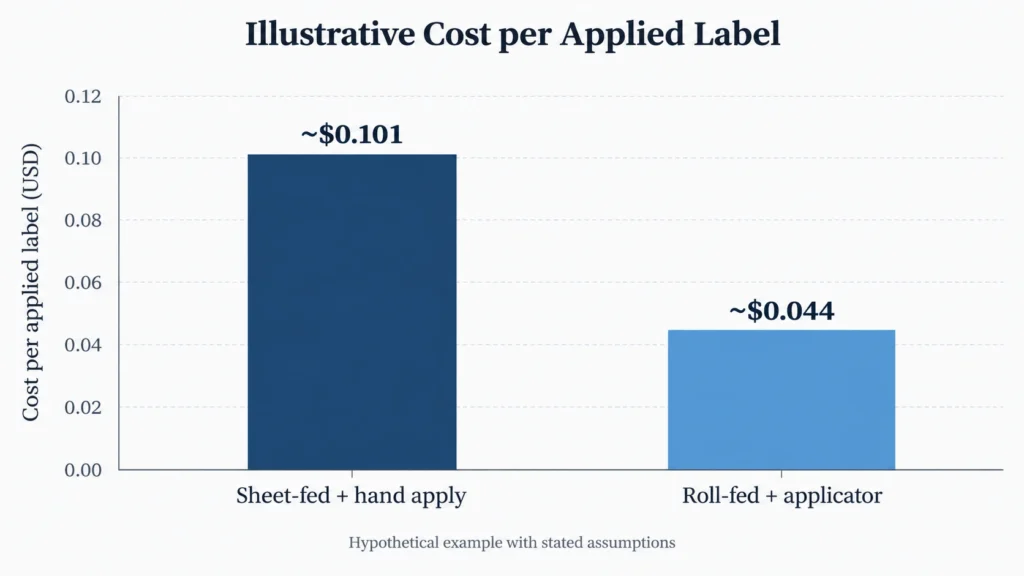
This is a hypothetical model with stated assumptions, not measured data. Substitute your own figures. Assume a 10,000-unit run and fully loaded labor at $30 per hour ($0.50 per minute):
| Cost element | Sheet-fed + hand apply | Roll-fed + applicator |
|---|---|---|
| Printed label cost | $0.030 | $0.038 |
| Finishing/converting | included | $0.004 |
| Application labor | 8 sec/unit = $0.067 | negligible per unit |
| Waste + rework allowance | $0.004 | $0.002 |
| Illustrative cost per applied label | ~$0.101 | ~$0.044 |
Sheet-fed wins on price per printed label and loses badly on cost per applied label. Drop the volume to 200 units and the picture reverses: application labor is trivial at that scale, and no tooling or roll setup is justified.
Two costs deserve specific attention: re-converting sheets into rolls so they will run on an applicator, and overbuying to hit converter minimums on low-volume or seasonal SKUs. Both are common, and neither appears in a per-label quote.
Digital roll-to-roll production removed most of the plate-based economics that made short runs sheet-only, moving the practical breakeven down.
The old rule — short run means sheets — was built on plate-based economics. Roll to roll digital printing removed most of what made short roll runs expensive:
The practical effect: teams typically find the breakeven run length moves down substantially, and roll format becomes viable at quantities that would have been sheet-only under flexo. Treating “short run” as automatic justification for sheets is no longer a safe default.
Digital roll production also fits cleanly into operations automation. Label jobs can be triggered by the production schedule rather than a separate purchase order, variable fields can be pulled from a system of record so lot and date data is never retyped, and inline verification can check codes before the web reaches rewind.
Eight criteria — from annual volume to lead-time sensitivity — determine whether an operation should lean roll or lean sheet.
| Criterion | Lean roll when… | Lean sheet when… |
|---|---|---|
| Annual volume | Tens of thousands or more | Hundreds to low thousands |
| Typical run length | Repeatable, a few hundred or more per SKU | One-off or under roughly 100 |
| SKU count | High mix with repeat orders | A handful of experimental items |
| Revision frequency | Frequent — print on demand, no obsolete stock | Rare, or single-use proofs |
| Application method | Automatic applicator or print-and-apply | Hand application, no applicator on site |
| Substrate/finish | Films, laminates, specialty adhesives at volume | Odd thicknesses, unusual finishes, small counts |
| Shape complexity | Repeating shape suited to a die or laser cut | Genuinely one-off shapes |
| Lead-time sensitivity | Same-day or next-day turns needed in-house | No urgency |
Most operations end up hybrid, and that is the correct answer: sheets for proofs, samples, and regulatory review copies; rolls for everything that touches a production line.
Arrow Systems, a manufacturer of digital label printing and finishing hardware, builds each ArrowJet as a roll to roll digital inkjet label printer configured around what happens after the print — producing rolls an applicator can actually run.
Whichever volume tier fits, each is a genuine roll to roll label printer built to hand off applicator-ready rolls — not a sheet-fed system adapted after the fact.
Arrow’s full range of label finishing systems handles the laminate, die-cut, matrix removal, and slit-and-rewind steps that turn a printed web into a roll an applicator can actually run.
Specifications vary by configuration. Validate print, substrate, adhesive, and finishing performance against your actual label sizes, materials, and line conditions before committing to a build.
Compare ArrowJet roll-to-roll configurations against your current converter spend.
Lower than most teams assume. Because digital roll production eliminates plates, needs little or no setup between SKUs, and can finish to applicator-ready rolls in-house, the practical breakeven usually sits well below traditional flexo thresholds. Many operations find that repeat runs in the few-hundred-label range already favor roll format once application labor and inventory obsolescence are counted. The exact point depends on label size, substrate, finishing requirements, and how much hand-application labor the sheet alternative would demand.
What to carry into your own review:
Pick two or three real SKUs — ideally one high-volume item, one frequently revised item, and one you currently hand-apply — and let Arrow Systems run a format and cost-per-applied-label review for packaging, operations, and QA teams.
We map current run lengths, revision frequency, substrate and finish requirements, and your applicator specs (unwind direction, core ID, maximum roll OD, label pitch), then show where sheets are costing you labor. You get a clear roll-versus-sheet recommendation and an ArrowJet configuration path — press and finishing — that can be phased in on one line first.
Table of Contents Roll-to-Roll vs. Sheet-Fed Label Printing: Throughput & Cost Rolls win on cost per applied label with an automatic applicator; sheets win on

Table of Contents Pet Food Brand Label Supplier Problems: 5 Signs to Print In-House Most pet food label supplier problems are a model mismatch: flexo’s

Table of Contents Coffee Roaster Flexible Pouch Printing Workflow: Roll to Bag In-house coffee pouch printing runs five stages — substrate loading, queue setup, the
Table of Contents Overlaminate vs. Varnish Labels: How to Choose Protection Film overlaminate protects against immersion, wash-down, and solvents; UV and aqueous varnish suit retail
Table of Contents Blade vs. Laser Label Die Cutting: Accuracy, Speed, and Cost per Label Blade die-cutting suits simple shapes and long runs; CO2 laser
Table of Contents GHS Label Durability Failure: 4 Causes and Practical Fixes GHS label durability failures trace to four causes: aqueous ink chemistry, paper face