Craft Brewery In-House Label Workflow: Design File to Roll
Table of Contents Craft Brewery In-House Label Workflow: Design File to Roll An in-house brewery label workflow is a four-step chain: controlled artwork, a calendar-driven

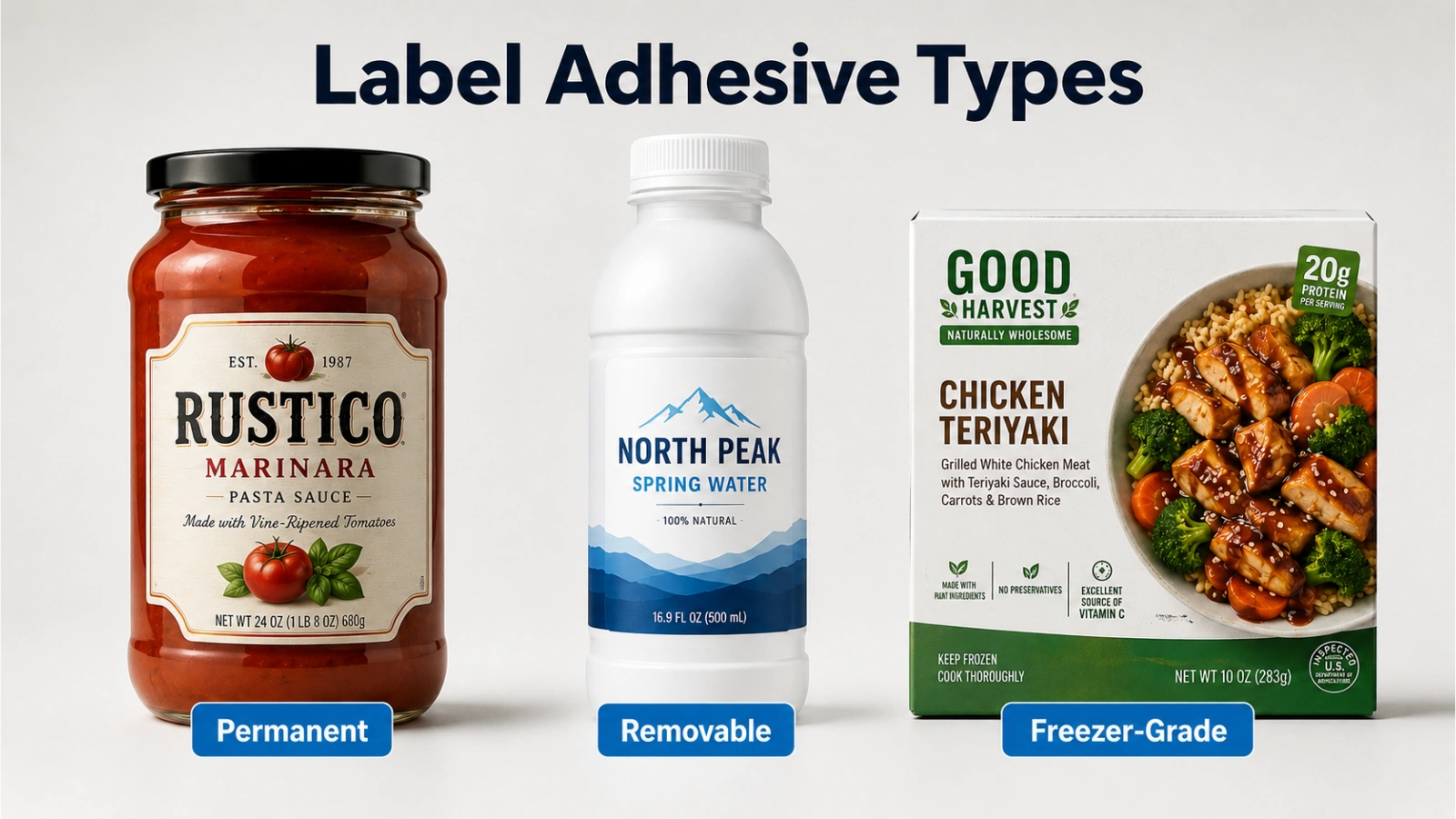
Label adhesives fall into three working classes — permanent, removable, and freezer-grade — matched to surface, environment, and removal needs.
Adhesive mismatches surface as field failures, not printing defects — curled freezer labels and shredded keg collars trace back to the spec, not the press.
This guide is written for packaging engineers, operations and line leads, and QA teams in food, beverage, chemical, and life-science manufacturing who own label failures when they reach the field. A pallet of entrées can leave the blast freezer with every label corner curled. A returnable keg collar can shred during removal and leave residue that has to be scrubbed by hand. Neither is a printing problem; both are adhesive-specification problems.
The sections below cover the four variables that drive most field failures, the observable symptoms of each misspecified adhesive class, a container-to-adhesive shortlist matrix, and a qualification workflow that can run before committing to a production quantity.
Almost every adhesion failure traces back to one of four inputs: how the label is applied, what it is applied to, what happens afterward, and how it must come off.
Application conditions
Surface temperature at the moment of application, cleanliness, condensation or free moisture, line speed, applicator pressure, and how much dwell time the bond gets before the package is handled or chilled.
Container material and surface energy
Glass and PET generally accept pressure-sensitive adhesives readily. Polyolefins such as HDPE and PP are lower surface energy and need adhesives formulated for them. Recycled resin content, mold release, silicone slip agents, plasticizers, and surface texture all reduce achievable bond.
Service environment
Ambient warehouse, refrigerated, freezer and thaw cycling, hot-fill or pasteurization, caustic wash-down, solvent or oil contact, and outdoor UV exposure each drive different facestock, adhesive, and laminate combinations.
End-of-life requirement
Permanent bond, clean removal, repositionable adhesive labels that can be lifted and reapplied, or tamper-evident destruction. This is the variable most often left undefined in the label spec, and the one that creates the most rework.
Permanent adhesives are built to reach maximum bond and stay there for the life of the package — treat them as effectively unremovable once the bond has built.
Permanent adhesive labels are the default choice whenever a label has to survive the full life of the package without lifting, scuffing loose, or being peeled off by the end user.
Best-fit applications: primary product labels, nutrition and drug facts panels, GHS hazard label adhesive constructions required under OSHA’s Hazard Communication Standard, case and pallet labels, asset tags, and anything that must survive handling, distribution, and consumer use without lifting.
Application conditions they require: a clean, dry surface at or above the supplier’s recommended minimum application temperature, adequate applicator pressure, and time. Most permanent pressure-sensitive adhesives grab quickly but continue building bond over hours. Judging adhesion at the end of the line, seconds after application, tells you very little about final performance.
High-tack variants exist for the hard cases: textured HDPE, low surface energy polyolefins, recycled-content resin, coated corrugate, and small-diameter or compound-curved containers where the facestock is fighting to lie flat.
Adhesive bleed or ooze at die-cut edges
Coat weight too aggressive for the construction, or facestock and liner mismatched at the finishing step; shows up as matrix cling and dirty die stations.
Facestock tearing during rework
A permanent adhesive was specified where an overlabel or clean-removal step was actually needed.
Residue and scuffed containers on returnables
Over-specification; a wash-off or removable class was the right call.
Print smear or discoloration weeks after application
Plasticizer or additive migration from the container into the adhesive and facestock, common on flexible PVC and some soft polyolefins.
Removable adhesives are formulated to release without residue under defined conditions — removable within a window and on defined surfaces, not permanently peelable.
Removable adhesive labels trade some of that permanence for controlled release, and the trade only holds within the manufacturer’s specified removal window and surface range.
Best-fit applications: promotional and price overlabels, temporary WIP and routing identification, returnable glass and rental asset labels, protective and instructional labels, and anything a customer will peel off.
Application conditions they require: smooth, non-porous, clean surfaces such as glass, PET, and coated films. Confirm the removal window actually needed — days, months, or a full season — and the temperature the label will see in between.
Low tack adhesive labels release with the least residue risk but also carry the least holding power, so match tack level to how long the label must stay in place before removal.
Residue or facestock splitting after months in service
Many removable adhesives migrate toward permanent behavior over time, and heat accelerates it.
Residue on porous or painted surfaces
Coated board, unfinished wood, and painted metal can allow adhesive anchoring or pull the coating off with the label.
Edge lift and flagging on small diameters and squeeze bottles
The facestock’s memory exceeds the adhesive’s tack; conformability matters as much as the adhesive.
Labels dislodging in transit
Removable was specified where repositionable-then-secure performance was needed; evaluate a higher-tack removable or an ultra-removable film construction instead.
Cold-service adhesion means the bond survives freezer temperatures after warm application; cold-temperature application means the adhesive can still wet out on a chilled or damp surface.
Specifying a label adhesive for cold storage means solving two separate problems, not one: the bond has to build and hold at low temperature, and the facestock has to keep printed data legible through repeated freeze-thaw cycling.
Best-fit applications: frozen food and entrée packaging, ice cream and novelty containers, refrigerated meat and dairy, blood and specimen identification, and cold-storage inventory labels. Specimen and lot-tracking applications in particular often call for peelable freezer labels rather than a permanent bond, so confirm the removal requirement alongside the temperature requirement before specifying.
Application conditions they require: in most operations, apply before deep-freeze exposure rather than to already-frozen, condensation-covered packaging. Frost and free moisture block adhesive contact with the container, so a standard freezer-grade stock applied to a frosted surface never bonds at all. If labels must go on frozen containers, specify an adhesive formulated for low-temperature application and confirm the wet-surface limits with the material supplier.
Facestock and topcoat choices matter as much as the adhesive here. Ice crystals, thaw condensation, and cooler handling all attack print durability, so topcoated films or laminated constructions are common for variable data that has to remain scannable after thaw.
Corner lift after blast freezing
Insufficient dwell time between application and freezer entry, or a standard permanent adhesive used for cold service.
Complete label loss
Applied to a frosted or wet surface where the adhesive never made contact.
Smeared barcodes and dates after thaw
Facestock and topcoat specified for dry ambient conditions.
Flagging on flexible film bags
Facestock too stiff for a substrate that moves and stretches.
When the package gets hot, washed, or wetted with chemicals, the adhesive is only part of the construction — facestock, topcoat, and laminate carry equal weight.
Specifying a chemical resistant label adhesive starts with matching the adhesive class to the exposure — solvent, caustic wash-down, oil, and sustained heat each stress the bond differently and call for different constructions.
Where these constructions apply: hot-fill and pasteurized beverages, retort pouches and trays, steam and caustic wash-down areas, elevated-temperature storage, drum and pail labeling with solvent or oil contact, surfactant and cleaner packaging, and outdoor equipment tags exposed to UV and rain.
What to specify alongside the adhesive: synthetic film facestocks in place of paper, a topcoat or overlaminate matched to the print method, and a laminate that seals the printed image against abrasion and chemical wicking from the label edge inward.
Edge lift and darkened adhesive after wash-down
Water wicking under the label at unsealed die-cut edges.
Ink lifting or dulling after chemical contact
No topcoat or laminate specified for the exposure.
Label shift or wrinkle during hot-fill
Adhesive softening at fill temperature before the container cooled.
Faded or cracked labels outdoors
Facestock and inks not selected for UV exposure.
Food-contact, indirect-contact, and cold-chain suitability should be confirmed against the material supplier’s documentation and applicable FDA requirements with the internal quality function before a construction is released. Arrow Systems sells digital label printing hardware; Arrow does not provide regulatory or compliance advisory services.
Use the matrix below as a starting shortlist, then qualify on real containers before committing to volume.
Container / Surface | Service Environment | Adhesive Class to Evaluate |
Glass bottle or jar | Ambient, refrigerated | General-purpose permanent |
Returnable glass, keg collar | Wash and reuse cycle | Removable or wash-off |
PET bottle or jar | Ambient, refrigerated | Permanent, film facestock |
HDPE / PP, textured or squeeze | Ambient to refrigerated | High-tack permanent, conformable facestock |
HDPE / PP with recycled content | Ambient, outdoor | High-tack permanent, verified per resin lot |
Coated board carton | Frozen, thaw cycling | Freezer-grade permanent |
Film pouch or bag | Frozen | Freezer-grade, flexible facestock |
Metal drum or pail | Solvent, oil, outdoor | Permanent, film facestock plus laminate |
Glass or plastic bottle | Hot-fill, pasteurization | High-temperature permanent, film facestock |
Treat this matrix as a starting shortlist, not a final verdict. Final selection should always be validated on your actual containers, environment, and application conditions.
Geometry effects to check
Small diameters — roughly two inches and under — compound curves, recessed panels, and squeeze bottles all put continuous stress on the label edge. Flagging in these applications is usually a facestock stiffness problem as much as an adhesive tack problem.
Supplier variability
Container lots from different plants can differ in mold release, resin blend, texture, and recycled content. Qualify with containers from the supplier and lot you will actually run.
Run a short, documented trial instead of a full production run — most teams complete the sequence below inside a week, depending on required environmental cycling.
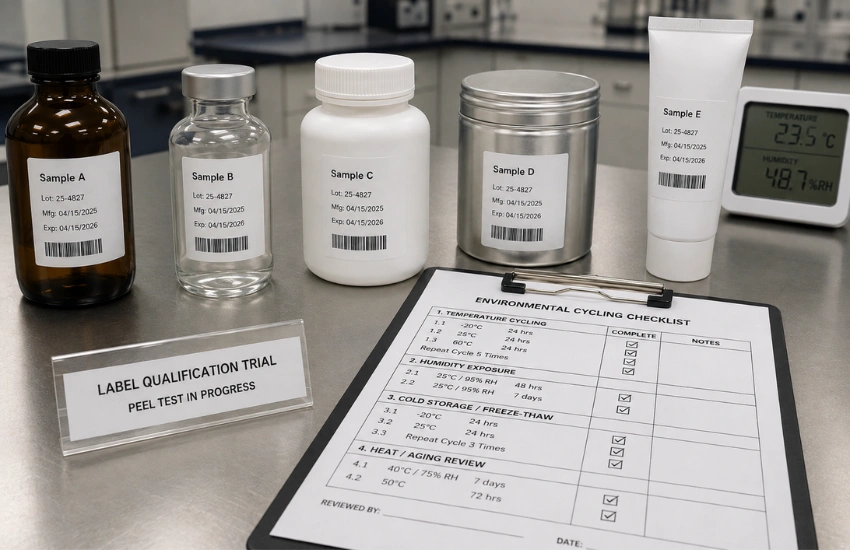
That last step is where operations automation pays off. Tie the approved construction to the SKU in the label data so the correct stock is called out at every changeover instead of living in tribal knowledge or an old vendor email.
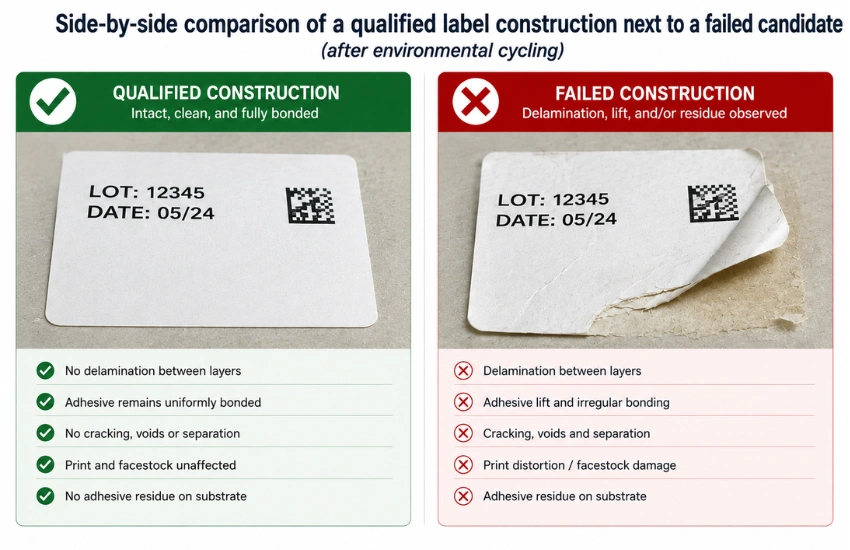
Arrow Systems, a manufacturer of digital label printing hardware, builds presses that let teams print and qualify real candidate constructions before committing to volume.
Construction thinking
Topcoat and facestock selection determine print quality and durability, while liner selection affects die-cutting, matrix stripping, and dispensing on the applicator. A construction that adheres well but will not dispense cleanly is still a production problem — facestock, adhesive class, liner, and topcoat or laminate need to be qualified as one system, not separately.
Short-run qualification on ArrowJet presses
Digital label printers such as the ArrowJet Aqua 330R, ArrowJet Eco 330R, and ArrowJet UV 330H let teams print real labels on two or three candidate constructions without committing to large minimum order quantities, so the qualification workflow above can be run with actual artwork and variable data rather than generic proofs. The ArrowJet Aqua 330R is Nestlé Guidance Compliant, producing digital pressure sensitive labels for pharma, cosmetic, food and beverage, nutraceutical, and flexible packaging applications — the same verticals where adhesive misspecification most often shows up in the field.
Controlled per SKU
Once a construction passes qualification, it can be locked to the SKU so the same facestock and adhesive class load at every changeover, across lines and shifts. See Arrow’s full range of digital label printers for the press configurations available for in-house short-run qualification and production.
Compare candidate constructions for one problem SKU before reordering stock.
Common questions from packaging engineers, operations leads, and QA teams specifying permanent, removable, and freezer-grade label adhesives.
Usually not all of them, but most operations can consolidate more than they expect. A general-purpose permanent adhesive often covers ambient glass, PET, and standard paperboard applications. Freezer SKUs, returnable containers, wash-down environments, chemical packaging, and low surface energy polyolefins typically need their own constructions. A practical target is a small qualified set — one general-purpose permanent, one high-tack, one freezer-grade, one removable — rather than a unique stock per SKU. Consolidation reduces changeover errors and inventory, but only for applications that have actually been tested.
Not reliably, unless it is specifically formulated for low-temperature application. Most freezer-grade adhesives are designed to be applied at normal or chilled temperatures and then survive freezer service. Frost, ice crystals, and condensation sit between the adhesive and the container, prevent wet-out, and the label releases as soon as the package is handled. If already-frozen or damp packaging must be labeled, request an adhesive rated for cold, wet-surface application and confirm the minimum application temperature and moisture limits with the material supplier before committing.
Removable adhesives release cleanly within a defined window and on defined surfaces. Over time, and faster under heat, the adhesive continues to flow into the surface and behaves closer to permanent. Textured, porous, or painted surfaces accelerate this because the adhesive anchors mechanically. Sunlight, warm warehouses, and hot trailers all shorten the clean-removal window. If the removal event happens months after application, specify the required removal interval and the maximum service temperature up front, then verify removal at the end of that interval during qualification.
Isolate one variable at a time. Apply the same label stock to a known-good surface such as clean glass and condition it; if it holds, the container surface is suspect, so check for mold release, slip additives, texture, or a resin change. Next, apply the same stock by hand with firm pressure and compare it with line-applied labels; a difference points to applicator pressure, dwell, or surface temperature. Finally, test an alternate adhesive class on the failing container. Record the results in the SKU spec so the finding survives staffing and supplier changes.
Define the end-of-life requirement first, separate cold service from cold application, and qualify on production containers before committing to volume.
Pick the two highest-risk SKUs — the one that generates the most field complaints and the one with the toughest environment — and qualify them instead of guessing. Arrow Systems can review your container materials, application conditions, and service environments, then supply short-run ArrowJet digital label samples printed on candidate constructions so your team can test real labels on real containers before committing to volume.
You end with documented, per-SKU label specs that plug directly into your changeover and operations automation workflow.
Table of Contents Craft Brewery In-House Label Workflow: Design File to Roll An in-house brewery label workflow is a four-step chain: controlled artwork, a calendar-driven
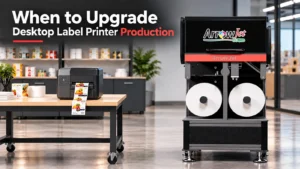
Table of Contents When to Upgrade From a Desktop Label Printer to Production Upgrade from a desktop label printer to a roll-fed production press when
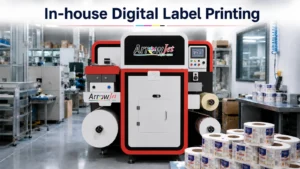
Table of Contents Why Print Your Own Product Labels: Speed, Control, and On-Demand Flexibility In-house digital label printing removes outsourcing delays, eliminates minimum order quantities,
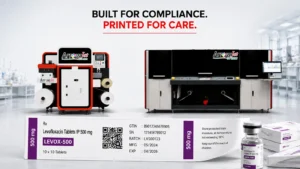
Table of Contents Aqueous vs. UV Inkjet Pharmaceutical Labels: What GMP Requires No FDA regulation names a compliant ink chemistry — GMP governs label accuracy,
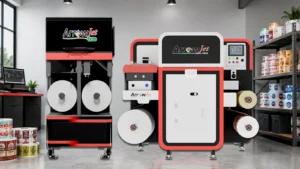
Table of Contents Color Sticker Printer for Business: 4 Reasons to Print In-House Businesses invest in a color label printer to reduce dependence on outside
Table of Contents Digital Label Printer for a Small Brand: The Real Break-Even Math Break-even for an in-house digital label press is driven by SKU