Pet Food Brand Label Supplier Problems: 5 Signs to Print In-House
Table of Contents Pet Food Brand Label Supplier Problems: 5 Signs to Print In-House Most pet food label supplier problems are a model mismatch: flexo’s

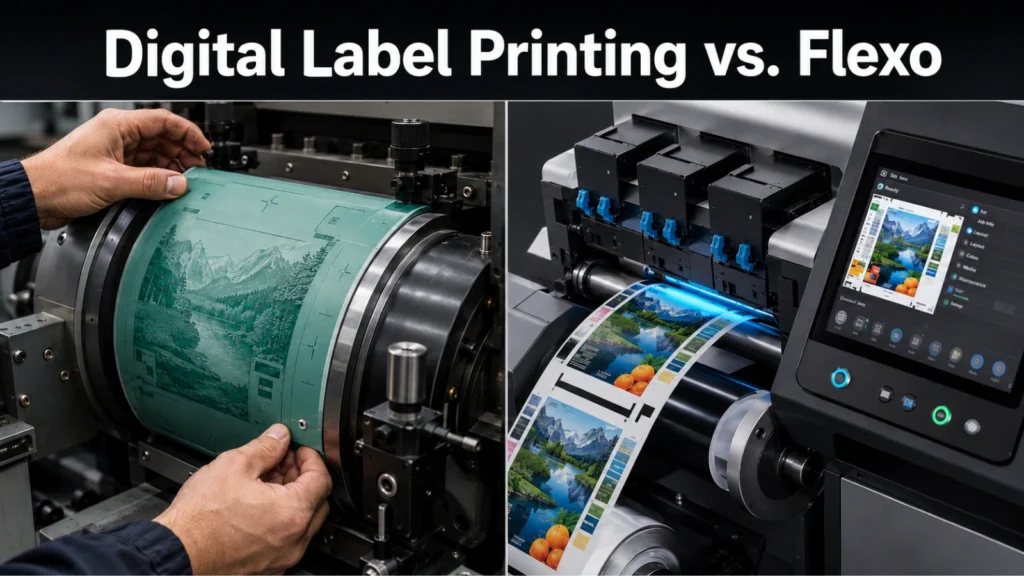
Digital label printing vs flexo comes down to one number: the run length where their two cost curves cross, not a guess.
Both flexo and digital produce excellent labels — what separates them is where the money goes across a job, not which one prints “better.”
This label print cost comparison starts with a structural difference, not a quality difference. Framed as digital printing vs flexographic printing, the real question is where each job’s cost sits — in setup or in the per-label consumable line — not which technology is inherently better.
This guide is for label operations decision-makers — ops, engineering, and the leaders who sign off on press strategy — running narrow web digital printing and flexo lines while juggling growing SKU counts and shrinking order sizes. Flexo front-loads cost into setup: plates, dies, and makeready are paid before the first sellable label comes off the press. Digital spreads cost evenly across every unit instead, with almost no setup penalty. You’ll leave with a break-even formula, a worked example, and a routing model for when to run each process.
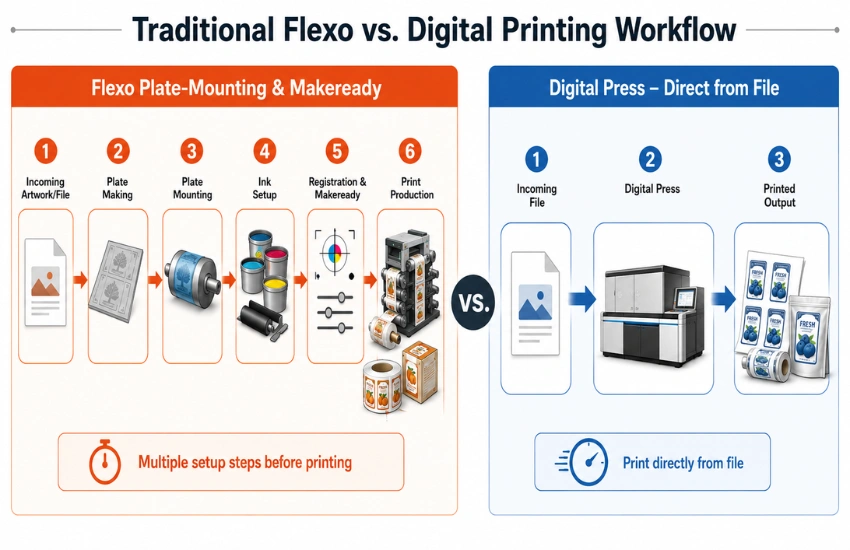
Flexo transfers ink from raised plates that must be mounted and registered before printing; digital prints directly from a file with no plates and minimal setup.
Understanding flexo vs digital label printing at the mechanical level is what makes each side’s cost structure predictable. The flexographic label printing cost model and its digital counterpart both trace directly back to how each press physically produces a label.
How flexo transfers ink to the substrate
Flexography is a relief printing process. Each color in a design requires its own flexible printing plate, and the label shape typically requires a dedicated die. Ink transfers from an anilox roller to the raised areas of the plate, then onto the substrate as it runs through the press at high speed.
Why setup defines flexo’s cost profile
Before a single sellable label comes off the press, an operator mounts plates, installs the die, dials in registration and color, and runs makeready material to confirm quality. That is real time, labor, and wasted substrate — all incurred before unit one. Once the press is dialed in, flexo is fast and the incremental cost per label is very low. High fixed setup paired with low per-unit cost is the whole story of flexo economics.
How digital inkjet prints without plates
Digital inkjet and toner-based label presses print directly from a file. There are no plates, and in many workflows no dedicated cutting die, because finishing can be handled with laser or digital die-cutting instead. You send artwork, and the press prints it. This roll to roll digital printing approach means the press moves straight from file to finished label with no physical setup step in between.
Why digital’s cost sits in the per-unit line, not setup
Because there is almost no physical setup, the fixed cost per job is minimal — you can print 200 labels or 20,000 with roughly the same near-zero startup penalty. The trade-off shows up per unit instead: ink and specialized substrate costs on digital are typically higher per label than flexo’s marginal cost once flexo is running. That is the mirror image of flexo’s economics — low fixed cost, higher per-unit cost.
Every label job carries two cost components — a fixed setup cost paid once and a per-unit cost paid on every label — and the split between them is what creates a break-even point at all.
Cost Type | What It Includes | Which Process It Dominates |
Fixed setup cost (paid once per job or SKU) | Printing plates (one per color), cutting dies and tooling, makeready material and labor, press wash-up between jobs, changeover and registration time | Flexo — loads heavily into this bucket |
Per-unit cost (paid on every label) | Ink or toner consumption, substrate and liner, marginal running labor and press time | Digital — loads heavily into this bucket |
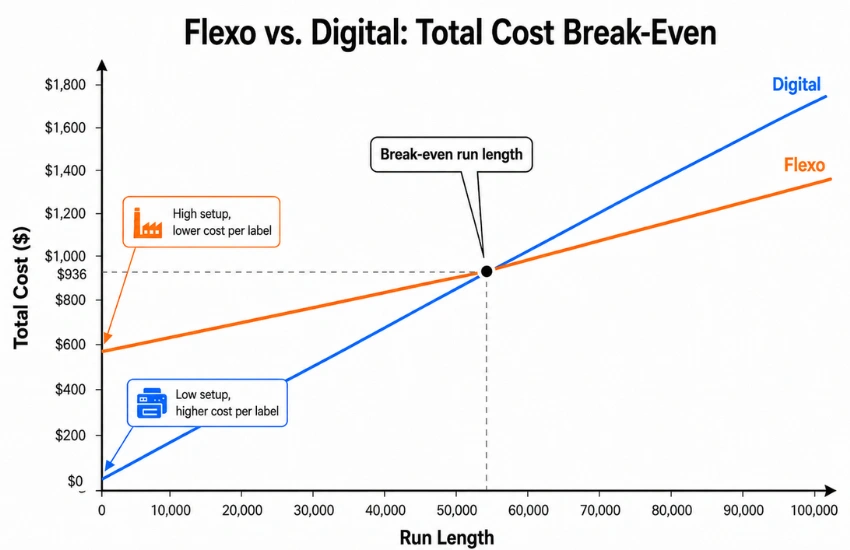
The flexo setup cost vs. digital difference is the entire reason a break-even point exists: flexo starts expensive and gets cheaper per label as volume grows, while digital starts cheap and stays flat. Plot both as a line — fixed cost as the y-intercept, per-unit cost as the slope — and they cross at exactly one run length. Below that point, digital wins. Above it, flexo wins.
The break-even run length is where flexo’s and digital’s total-cost lines intersect, and it is calculable from a single formula.
The break-even formula
Break-even quantity = (Flexo setup cost − Digital setup cost) ÷ (Digital per-unit cost − Flexo per-unit cost). Solve it with your own quote line items — plate cost, die cost, makeready waste, and per-label ink and substrate cost — rather than a memorized rule of thumb. Treat it as a break-even run length label printing calculation you run per SKU, not a one-time company-wide rule.
The numbers below are illustrative only and show the mechanics. Real figures depend on press, substrate, color count, labor rates, and shop overhead — validate them against your own quotes. Assume a single four-color SKU:
Input | Flexo | Digital |
Setup cost per SKU | ~$400 (plates, die, makeready, wash-up) | ~$25 (file prep, minimal makeready) |
Per-label cost | ~$0.010 | ~$0.017 |
Plug into the formula: Break-even = ($400 − $25) ÷ ($0.017 − $0.010) = $375 ÷ $0.007 ≈ ~53,000 labels. In this illustrative scenario, below roughly 53,000 labels digital is cheaper; above it, flexo pulls ahead. Change any input — fewer colors for cheaper flexo plates, a pricier digital substrate, or higher makeready waste — and the crossover shifts, sometimes dramatically.
Short runs favor digital
Digital almost always wins on short runs because flexo’s setup cost has too few units to spread across.
Long runs favor flexo
Flexo wins on long runs because its low per-unit cost eventually overwhelms its high setup cost.
The middle is where teams get it wrong
Mid-range run lengths are where operations most often rely on a memorized rule of thumb instead of running their own numbers. There is no universal magic number — the break-even falls somewhere in a broad range depending on color count and setup complexity, which is exactly why the flexo plate cost and makeready line items on a quote matter so much. When quotes bury those costs, an accurate short-run break-even calculation becomes nearly impossible.
The single-run break-even formula assumes one design and one long run — real portfolios fragment that into many small ones, and versioning is the hidden multiplier that shifts the math.
SKU proliferation, regional variants, multi-language panels, promotional editions, and private-label work all fragment what used to be one big order into many small ones. Consider a total annual demand of 100,000 labels. As one SKU, flexo likely wins outright. But split that same volume into 20 versions of 5,000 each, and everything changes.
For a digital label printing short run, near-zero setup cost is what makes fragmented, versioned portfolios economical — flexo can’t say the same about a run of a few thousand short run labels.
Flexo pays setup on every version
With flexo, you now pay setup 20 times — 20 plate sets, 20 makereadies, 20 wash-ups. Each version resets flexo’s fixed cost from zero, collapsing one economical long run into many uneconomical short ones.
Digital’s setup cost stays near zero per version
With digital, you pay near-zero setup 20 times, and versions can change on the fly using variable data. In this scenario the effective break-even shifts hard toward digital — often decisively — even though total volume never changed. This label versioning cost dynamic is the single biggest reason digital wins portfolios that look, on paper, like a flexo job.
The quieter cost: overproduction to hit MOQs
To justify flexo minimum order quantities, teams frequently over-produce to hit MOQs, then scrap obsolete labels when a formula, claim, or design changes. That waste and inventory carrying cost never shows up on the per-label quote, but it is real money.
The practical conclusion isn’t “replace flexo” or “digital is the future” — it’s hybrid label printing: run both, and route each job to whichever process sits on the winning side of its own break-even curve.
Long, stable, high-volume runs → flexo
Flexo remains the right process where its low per-unit cost dominates over a large, predictable run.
Short runs, versioned SKUs, and on-demand reorders → digital
Digital wins where zero setup and variable data matter most — prototypes, versioned SKUs, and reorders that don’t justify a new plate set. Arrow Systems’ range of digital label printers is built for exactly this side of the curve. As commercial digital label printers, this digital label printing equipment runs direct from file, with no plates or dies to mount between versions.
Hybrid production shortens lead times on the short-run tail
Switching from flexo to digital for the short-run tail can turn multi-week, plate-dependent lead times into same-day or next-day production, without forcing short, versioned jobs onto a press whose economics punish them.
Routing can be built into the workflow, not decided job by job
When label production is triggered directly from ERP or production-planning data — printing the right version in the right quantity just before it’s needed — operations compress changeovers, cut manual version-control errors, and shrink the obsolete-inventory problem that MOQ-driven overproduction creates. The digital-vs-flexo routing decision can be built into that workflow rather than made manually on every job.
Calculate your own break-even from real quote line items, isolate flexo’s setup costs, model versioning explicitly, and route by the curve.
Step 1: Calculate your own break-even from real quote line items
Pull actual plate, die, makeready, ink, and substrate costs from your own quotes rather than relying on a borrowed rule of thumb. The formula only works when the inputs are real.
Step 2: Isolate flexo’s plate and makeready costs on every quote
When setup costs are bundled into a single line, the crossover point stays invisible. Separating them out makes the break-even calculation possible in the first place.
Step 3: Model versioning explicitly
Each version resets flexo’s fixed setup cost. Run the break-even formula per version, not just per total annual volume, to see how a fragmented SKU mix actually shifts the math toward digital.
Step 4: Route each job by the curve, not by habit
Send long, stable, high-volume runs to flexo and short, versioned, on-demand runs to digital. Where volume is high enough to consider automating the routing decision from ERP or production-planning data, that removes the guesswork from day-to-day job assignment.
Common questions from label operations, engineering, and procurement teams weighing digital label printing against flexo on cost.
For most label applications, modern digital inkjet quality is competitive with flexo, including fine text, barcodes, and regulatory panels. Quality still depends on substrate, resolution, and appropriate finishing such as lamination for durability, so it’s worth running a print trial on your actual materials rather than assuming parity or inferiority either way.
Dramatically. Each version resets flexo’s fixed setup cost, so splitting one long run into many short versioned runs multiplies plates, dies, and makeready. Digital carries almost no setup penalty per version and supports variable data, so its economics stay flat. The more a portfolio versions, the further the break-even point shifts toward digital — often to where digital wins even when total annual volume is high.
Most operations are best served by a hybrid approach rather than a full replacement. Keep flexo for long, stable, high-volume runs where its low per-unit cost dominates, and use digital for short runs, versioned SKUs, and on-demand reorders. Match each job to the winning side of its own break-even curve instead of committing to one technology for everything.
Rules of thumb are where good cost decisions go to die. The break-even that matters is the one built from your plate costs, substrate prices, run lengths, and versioning demands — and that number moves as your SKU mix evolves.
Arrow Systems manufactures digital label printing hardware built for the short-run, versioned side of that curve. Bring your job mix to a 20-minute labeling economics review, and leave with a defensible cost model you can put in front of leadership.
Table of Contents Pet Food Brand Label Supplier Problems: 5 Signs to Print In-House Most pet food label supplier problems are a model mismatch: flexo’s
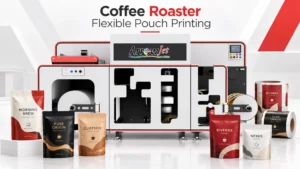
Table of Contents Coffee Roaster Flexible Pouch Printing Workflow: Roll to Bag In-house coffee pouch printing runs five stages — substrate loading, queue setup, the

Table of Contents Overlaminate vs. Varnish Labels: How to Choose Protection Film overlaminate protects against immersion, wash-down, and solvents; UV and aqueous varnish suit retail
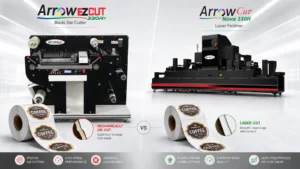
Table of Contents Blade vs. Laser Label Die Cutting: Accuracy, Speed, and Cost per Label Blade die-cutting suits simple shapes and long runs; CO2 laser
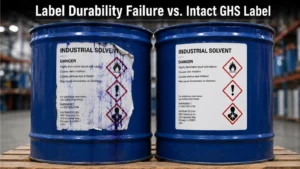
Table of Contents GHS Label Durability Failure: 4 Causes and Practical Fixes GHS label durability failures trace to four causes: aqueous ink chemistry, paper face
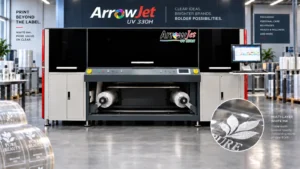
Table of Contents White Ink Clear Label Printing: When You Need It and Why White ink under clear film keeps brand color, mandatory copy, and