GMP Label Printing for Supplements: A Manufacturer’s Guide to 21 CFR Part 111
Table of Contents GMP Label Printing for Supplements: A Manufacturer’s Guide to 21 CFR Part 111 GMP label printing for supplements means producing every bottle

GMP label printing for supplements means producing every bottle label — identity, lot, and expiry — under a validated, on-demand workflow tied to the batch record.
Compliance obligations should always be confirmed with your internal QA and regulatory teams; this article is operational guidance, not legal advice.
21 CFR Part 111 establishes current Good Manufacturing Practices for dietary supplements, and its labeling expectations are enforced alongside broader pharmaceutical labeling regulations. Your QA and regulatory teams should confirm the specifics for each product, but the identifiers typically required on a finished supplement label include:
Statement of identity and net quantity of contents, as required under FDA labeling regulations.
Required nutrient and ingredient disclosures, including serving size and all listed dietary ingredients.
Contact information identifying the responsible party for the finished supplement.
A unique code tied to the batch production record, enabling end-to-end traceability from finished goods back to raw materials and manufacturing conditions.
Where claimed or required by company policy; must match the batch record and product stability data.
Allergen disclosures, required safety warnings, and directions for use where applicable to the product category.
Labeling is a frequent audit finding area in pharmaceutical and nutraceutical manufacturing because it touches nearly every production run and depends on multiple upstream handoffs: formulation, artwork approval, regulatory review, production scheduling, and line execution. A breakdown at any one of those points can produce a noncompliant label — and the evidence is sitting in the warehouse.
Static pre-printed labels cannot carry information that changes every run. Lot numbers, batch codes, manufacturing dates, and expiry dates are variable by definition, and under GMP they must match the batch record exactly.
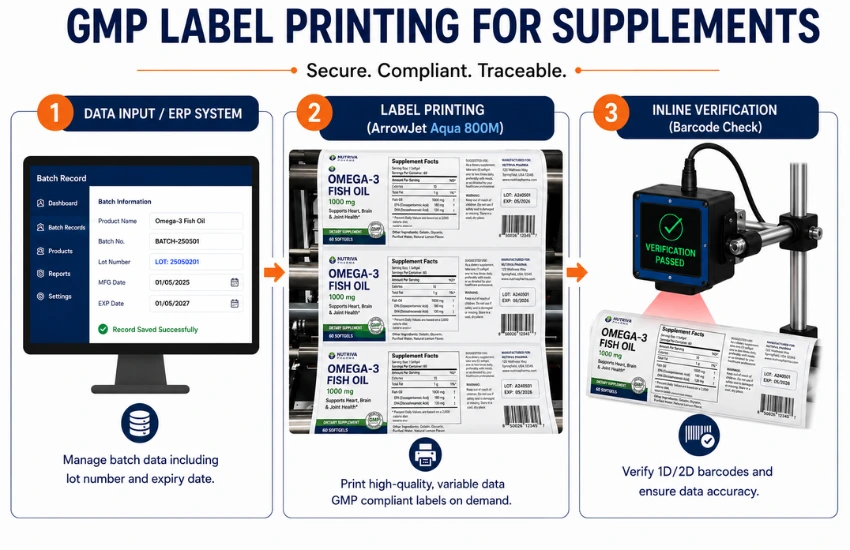
Variable data printing solves this by pulling run-specific data into the label at print time rather than stamping it on after the fact. In a well-designed nutraceutical batch labeling workflow:
Every label on every bottle should trace to the exact batch record that produced it, with no manual transcription step in between. That is the core of defensible lot number and expiry date printing under GMP.
On-demand printing retires superseded label versions immediately — without writing off pre-printed rolls as scrap.
When formulation changes, Supplement Facts panels are updated, or a private-label customer revises artwork, pre-printed rolls become scrap. On-demand printing retires the old version the moment it is superseded, without writing off thousands of labels.
Each print job references the currently approved artwork file — if a version is not released, it cannot print.
This closes one of the most common paths to a mislabeling event: an operator pulling an outdated roll from the label room. Moving label production in-house with role-based access and locked templates means only released artwork can reach production.
Reformulations, new claims language, and regulatory updates can move from approval to production in hours rather than weeks, closing the compliance risk window between approval and line implementation.
The gap between “we updated the label” and “the updated label is on the bottle” is itself a compliance risk window — on-demand printing collapses it.
Connecting label printing to production scheduling and batch records removes manual steps — entering a lot number, selecting a file, confirming an expiry date — where errors typically occur.
Each automated handoff is one less opportunity for a deviation.

A practical on-demand workflow includes approval gates (artwork released only after QA sign-off), role-based access to template libraries, a first-article check at the start of each run, inline verification during the run, and a reconciled label count at run close.
Different SKU profiles call for different hardware. Flagship products with steady, predictable demand run differently than short-batch private-label or clinical work. The comparison below summarizes where each system fits in a GMP supplement labeling operation.
| Criterion | ArrowJet Aqua 800M | ArrowJet Aqua 330R |
|---|---|---|
| Primary use case | High-volume, continuous digital production | Short- to mid-volume on-demand runs |
| Ideal SKU profile | Flagship SKUs with high monthly volumes | Private label, seasonal, trending, clinical batches |
| Artwork change frequency | Low to moderate; stable core artwork | High; frequent compliance and brand revisions |
| Variable data handling | Lot, batch, expiry, and serialized fields at production speed | Lot, batch, expiry with fast job-to-job changeover |
| Best fit for | Contract manufacturing under turnaround pressure; consolidation of pre-printed SKUs | Programs with many brand owners or pilot batches needing GMP-grade labels without long lead times |
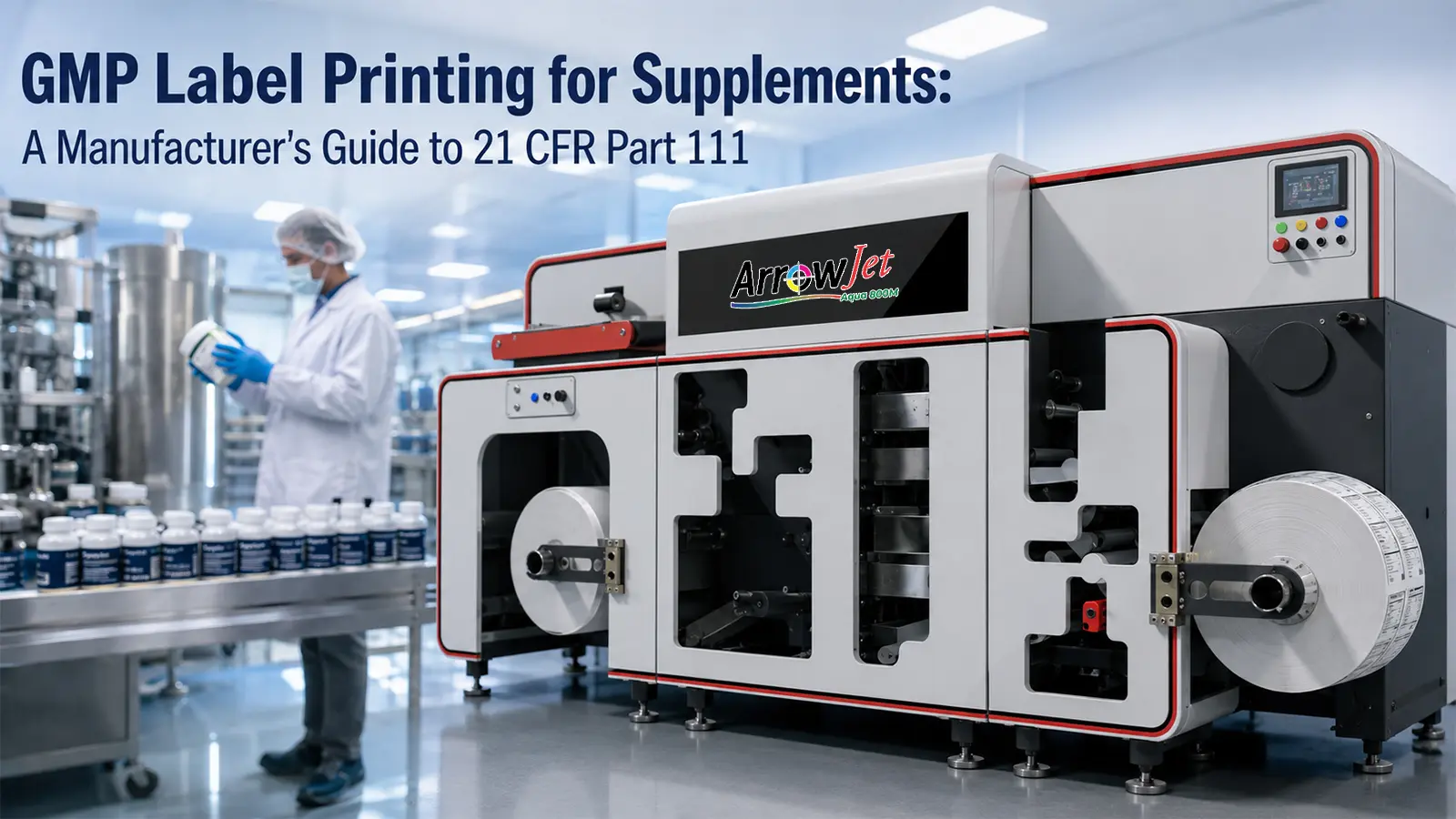
The ArrowJet Aqua 800M is built for continuous digital production, supporting variable data printing for lot, batch, expiry, and serialized fields at production speed.
It lets manufacturers produce large batch quantities without relying on pre-printed static stock. Its role in a GMP environment is to deliver consistent, high-throughput output with variable data tied directly to the batch record, so scale does not come at the cost of traceability.
The ArrowJet Aqua 330R is designed for on-demand, short- to mid-volume supplement label production with substrate flexibility suited to common nutraceutical packaging formats.
Not every SKU runs at flagship volume. Private-label work, seasonal products, trending ingredients, and clinical or trial batches often require shorter runs with frequent artwork updates — the Aqua 330R handles this profile with fast job-to-job changeover and no minimum run constraints.
Both systems are tools inside a validated workflow; the compliance outcome depends on how they are integrated with your SOPs, batch records, and verification controls.
A printer alone does not make a process GMP-compliant. Validation is what makes it defensible under audit. An operational validation package for in-house label printing typically includes:
Apply the standard three-phase qualification framework across installation, operational performance, and real-production consistency.
Documents that the equipment is installed per specification and meets site requirements before operation begins.
Confirms the equipment performs consistently across its intended operating range with your substrates and print parameters.
Demonstrates consistent output under actual production conditions with your approved substrates, label templates, and live variable data across multiple representative runs.
Every step from artwork approval through end-of-run reconciliation requires a written procedure with defined roles, separation of duties, and required records.
Written procedures must cover: artwork approval and release, template creation and locking, print job setup, first-article inspection, inline verification, reject handling, and end-of-run reconciliation.
Any change to artwork, templates, equipment settings, or the data pipeline goes through a documented change control process with QA approval before it reaches production.
Every operator running the equipment has documented training on the SOPs, with records of periodic requalification available for audit review.
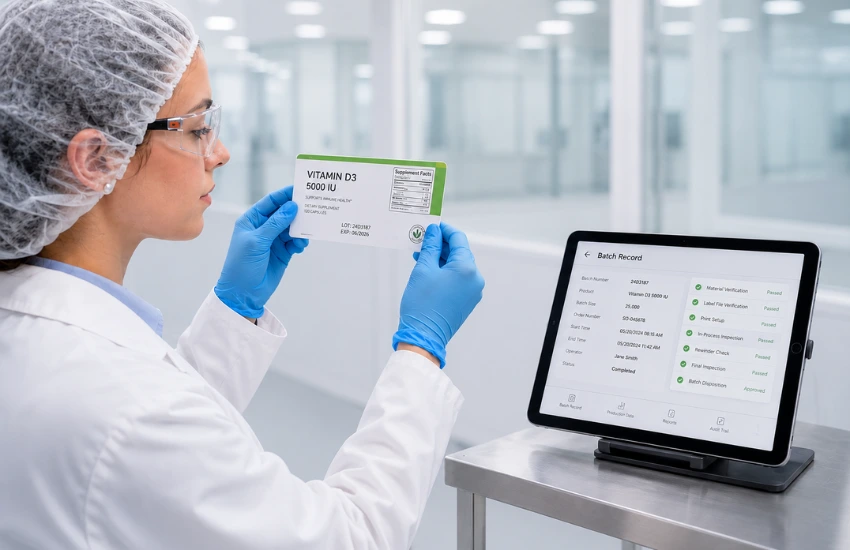
The first label of each run is inspected against the approved proof and batch record, signed off, and retained. Inline verification logs exceptions, rejects, and reconciliation data for the full run.
The electronic or paper batch record references the specific label version, lot, expiry, and print job used — creating a closed loop from raw material to finished label that is auditable at any point in the chain.
This documentation is what turns “we print our own labels” into “we operate a validated, audit-ready labeling process.”

Teams that move from pre-printed labels and manual coding to a validated on-demand workflow often see meaningfully lower obsolete label inventory, fewer labeling-related deviations, and materially faster response to artwork changes. Specific outcomes depend on SKU mix, volume, and the maturity of existing controls, and should be modeled against your own baseline.
21 CFR Part 111 governs GMP for dietary supplements and works alongside FDA labeling regulations that typically require product identity, net contents, a Supplement Facts panel, ingredient disclosures, manufacturer or distributor information, and batch traceability elements such as lot and expiry. Specific requirements for a given product should be confirmed with your QA and regulatory teams.
Yes. In-house printing is compliant when it is performed under a validated process with documented SOPs, approved artwork control, variable data sourced from the batch record, inline verification, operator training, and retained records. The equipment is one input; the surrounding quality system is what demonstrates compliance.
Apply an IQ/OQ/PQ approach: document installation against specification, qualify operation across your intended range, and demonstrate consistent performance under production conditions with your actual substrates and templates. Pair that with SOPs, change control, training records, first-article checks, and inline verification logs.
On-demand digital printing is typically the better fit when SKU counts are high, artwork changes frequently, run sizes vary, or obsolescence from reformulation and regulatory updates is a recurring cost. Pre-printed stock can still make sense for very stable, very high-volume SKUs, but many nutraceutical manufacturers find the control and flexibility of on-demand printing aligns more closely with GMP expectations.
If you’re managing frequent label revisions across multiple SKUs, carrying obsolete pre-printed inventory, or losing weeks to lead times every time a formulation or regulatory requirement changes, a structured evaluation can clarify your best path forward.
Arrow Systems offers 30-minute GMP labeling workflow assessments to review your current label workflow, variable data handling, version control, and audit readiness — and to identify whether the ArrowJet Aqua 800M or the ArrowJet Aqua 330R fits your SKU mix. Pair your press with Arrow’s label finishers for a complete in-house workflow.
This guide is informational and does not constitute legal or regulatory advice. Manufacturers should verify specific labeling requirements with their internal QA and regulatory teams and the applicable FDA guidance documents before finalizing artwork.

Table of Contents GMP Label Printing for Supplements: A Manufacturer’s Guide to 21 CFR Part 111 GMP label printing for supplements means producing every bottle

Table of Contents Cannabis Gummy Packaging: Labels, Flexible Pouches, and State Compliance — A 2026 Brand Guide Cannabis gummy packaging must meet child-resistant standards, opaque-material

Table of Contents AAFCO Pet Food Label Requirements: 2026 Brand Guide AAFCO pet food label requirements define eight mandatory elements every dog and cat food

Table of Contents Vitamin Bottle Labels: Materials, Inks, and Compliance Guide HDPE supplement bottles require substrate, adhesive, ink, and workflow decisions that are compliance decisions

Table of Contents Custom Dog Treat Bags: In-House Printing for Pet Brands Pet treat brands bringing packaging in-house with digital presses eliminate 4–8 week converter

Table of Contents FDA Supplement Label Requirements: 2026 Compliance Checklist Every dietary supplement sold in the U.S. must satisfy nine mandatory elements under 21 CFR