Pet Food Brand Label Supplier Problems: 5 Signs to Print In-House
Table of Contents Pet Food Brand Label Supplier Problems: 5 Signs to Print In-House Most pet food label supplier problems are a model mismatch: flexo’s
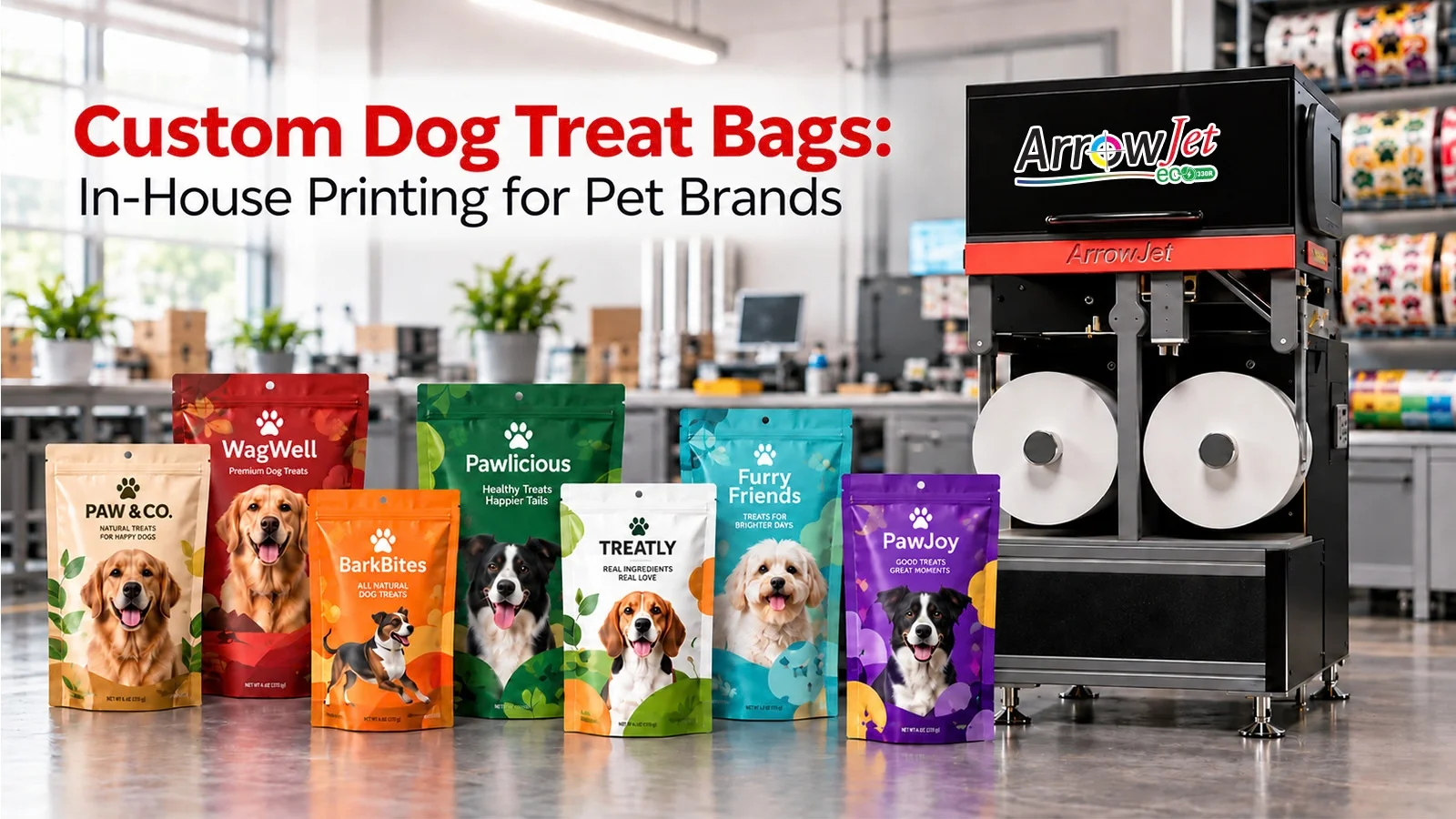
Pet treat brands bringing packaging in-house with digital presses eliminate 4–8 week converter lead times, remove minimum order constraints, and print AAFCO-aligned revisions the same day a formula or supplier changes.
Dog treat packaging combines shelf appeal, AAFCO-aligned regulatory content, and high SKU variability — creating an environment where pre-printed bag inventory ordered months in advance frequently goes obsolete before it is used.
Pet treat packaging carries more compliance and operational burden than most CPG categories. A single stand-up pouch must win shelf attention, reassure buyers on ingredient quality and sourcing, provide feeding guidance, and carry the labeling content that state feed control officials expect — all while remaining functional through distribution and reseal cycles at home.
Several structural factors compound the challenge for growing and mid-size pet treat brands:
Ingredient sourcing and formulas shift as brands respond to supply availability, consumer demand, and trend ingredients. Each change triggers an update to the guaranteed analysis, ingredient list, or both — making pre-printed bags ordered against the previous formula a liability.
Flavor variants, life-stage versions, and size formats multiply SKU counts quickly. Ordering converter-scale MOQs across a large SKU catalog locks capital into packaging inventory that may not clear before the next format change.
Short-run seasonal or limited-edition products are poor candidates for flexographic pre-print. The plate investment is not amortized over sufficient volume, and unsold inventory at season’s end represents direct write-offs.
More formulas, flavors, private-label variants, and international SKUs mean more label files to manage — and more pre-printed inventory to potentially scrap when a rule, formula, or supplier changes. Brands managing expanding SKU counts without a governed artwork workflow carry proportionally higher revision risk.
The result is pre-printed bag inventory ordered 6–10 weeks in advance that frequently goes stale — either because the label content changes or because demand did not materialize at the volume the converter MOQ required.
Dog treat packaging combines shelf appeal, AAFCO-aligned regulatory content, and high SKU variability — creating an environment where pre-printed bag inventory ordered months in advance frequently goes obsolete before it is used.
More formulas, flavors, private-label variants, and international SKUs mean more label files to manage — and more pre-printed inventory to potentially scrap when a rule, formula, or supplier changes. Brands managing expanding SKU counts without a governed artwork workflow carry proportionally higher revision risk.
Single-ingredient claims, sourcing callouts (e.g., “USA-raised chicken”), and functional benefit statements that address buyer intent around quality and origin. These statements must align with the ingredient list content on the label.
Treat use instructions, suggested quantities, and life-stage specifications. Required on products positioned as more than occasional snacks and expected on most retail products as a consumer-service element regardless of regulatory requirement.
Freshness indicators, resealability features, made-in origin statements, and quality signals that influence purchase decisions and reduce returns driven by product performance misalignment.
Product identity, net weight statement, guaranteed analysis, ingredient list in descending order by weight, feeding directions, nutritional adequacy statement where applicable, and manufacturer or distributor contact information. Covered in detail in the AAFCO section below.
If a brand manages twelve or more SKUs, this content changes by product and often mid-cycle. That operational reality is the core argument for on-demand in-house printing over converter pre-print.
Most pet treat brands use both formats — the decision is which SKUs belong in flexible pouches and which are better served by a wrap label on a neutral container.
Products sold through grocery, pet specialty, and mass retail channels in standard portion sizes where stand-up pouches or resealable zipper bags are the category-standard format.
SKUs where photography, illustration, and color coverage drive the purchase decision. Stand-up pouches provide the full-panel print area that label-on-container formats cannot match.
Oil-heavy or fat-rich formulations — jerky, raw-coated, or high-meat treats — that require moisture, oxygen, or grease barrier properties typically found in multi-layer flexible packaging films.
Holiday packaging, collaboration releases, and retailer exclusives that are not justified at converter MOQs but are practical at digital short-run production volumes.
Kraft stand-up bags, glass jars, and PET tubs with digitally printed wrap labels communicate a handcrafted or premium positioning that pre-printed flexible pouches often cannot replicate at short-run economics.
Larger-quantity formats where the container is a neutral vessel and the label carries all brand and compliance content. Particularly practical when the container is reusable or refillable and the label needs to change independently.
When the SKU mix changes faster than the container supply chain can respond, a neutral container with a versioned wrap label decouples the two. The container stays constant; the label updates as needed.
A common hybrid approach: core SKUs in custom printed stand-up pouches for primary retail, seasonal or limited releases on neutral kraft bags with digitally printed wrap labels, and bulk or foodservice configurations in labeled PET tubs.
AAFCO model regulations define the label elements state feed control officials typically expect on dog treat products — including guaranteed analysis, ingredient list, feeding directions, and manufacturer contact information.
The following is a practical operational reference — not legal advice. AAFCO is not a regulatory body; its model regulations are adopted and enforced at the state level. Verify current requirements with your regulatory contact or state feed control official for your specific products and markets.
| Label Element | What It Must Include | Operational Note |
|---|---|---|
| Product identity | Common or usual name plus a species designator (e.g., “dog treats,” “dog snacks”). | Must appear on the principal display panel. Species designator is required — “treats” alone is insufficient in most states. |
| Net weight statement | Declared in both U.S. customary and metric units. | Must appear on the principal display panel. Placement and type size requirements apply. |
| Guaranteed analysis | Minimum crude protein, minimum crude fat, maximum crude fiber, maximum moisture. Additional guarantees (e.g., omega fatty acids) may be required for specific claims. | Changes with any formula update. One of the highest-frequency label revision triggers for treat brands with evolving recipes or ingredient sourcing. |
| Ingredient list | All ingredients listed in descending order by weight. Common or usual names required. No trade names or proprietary ingredient descriptors without cross-reference. | Must reflect actual formula — any ingredient substitution or sourcing change that alters the ingredient or its ranking requires a label update. |
| Feeding directions | Recommended treat quantities and usage guidance. Required when the product is positioned as more than an occasional snack. | May need to vary by dog size or life stage for brands making targeted claims. Changes if the treat density, caloric content, or size changes. |
| Nutritional adequacy statement | When applicable — typically “intended for intermittent or supplemental feeding only” for treats not formulated to AAFCO nutrient profiles. | Required if the product could be misinterpreted as a complete and balanced diet. Confirm applicability with your regulatory contact. |
| Manufacturer or distributor information | Name and principal mailing address of the manufacturer, packer, or distributor responsible for the product. | Updates required on co-packer changes, address changes, or private-label arrangements where the responsible party changes. |
Any of these elements can change mid-cycle. A recipe adjustment triggers a guaranteed analysis and ingredient list update. A new co-packer triggers a manufacturer information update. A limited-edition collaboration triggers a new principal display panel. Pre-printing thousands of bags against current content creates direct exposure to that revision cycle.
Digital in-house production eliminates plate costs, MOQ constraints, and revision lead times; converter pre-print delivers lower per-unit cost only at stable, high-volume runs without frequent label changes.
| Factor | Converter Pre-Print (Flexo / Gravure) | In-House Digital (ArrowJet) |
|---|---|---|
| Plate / setup cost | $200–$1,000+ per color per SKU | None |
| Minimum order quantity | Typically 5,000–25,000+ units per run | No minimum — print what production needs |
| Lead time — new orders | 4–8+ weeks | Hours to same day (estimate; depends on format and finishing) |
| AAFCO revision turnaround | New plates required; 4–6+ additional weeks | File update; print immediately after approval |
| Seasonal / limited-run economics | Poor — plate cost not amortized over short run | Strong — no setup cost; print exact quantity needed |
| Obsolete inventory risk | High — any formula, supplier, or label change strands pre-printed stock | None — print only against current approved file |
| Per-unit cost at high stable volume | Lower than digital at very high, stable runs | Higher than flexographic at scale without revisions |
| Private-label and exclusive versioning | Additional plates and MOQ per version | Artwork changeover with no tooling cost |
| In-house operations required | None — outsourced to converter | Press operation, color management, QC, substrate management |
The economic tipping point depends on SKU count and revision frequency more than total volume. A brand managing 20 or more SKUs with frequent AAFCO-aligned updates typically finds in-house digital more cost-effective on a total-cost basis once eliminated obsolete inventory and lead-time carrying costs are included in the comparison.
The ArrowJet Eco 330R is designed for short-run digital flexible packaging — stand-up pouches, resealable zipper bags, and rollstock — on the film substrates common in pet treat packaging, without the plate, cylinder, or MOQ commitments of conventional flexo or gravure.
Handles the flexible packaging films used in pet treat stand-up pouches — including PET/PE laminates, OPP, and barrier films — without the plate investment or cylinder changes required by conventional flexographic equipment.
Print different SKU artwork, flavor variants, and limited-edition versions in a single production run without mechanical setup changes. Practical for brands managing seasonal drops, private-label work, or frequent recipe-triggered label revisions across a large SKU catalog.
No plates, cylinders, or minimum order quantities. A seasonal packaging version that justifies 500 units can be produced economically — unlike flexo, where the plate investment makes short runs cost-prohibitive.
Moves packaging production from a 4–8 week converter cycle to an in-house turnaround measured in days (estimate — actual results depend on format, finishing capacity, and run volume). Brands no longer need to forecast packaging demand months in advance to avoid supply gaps.
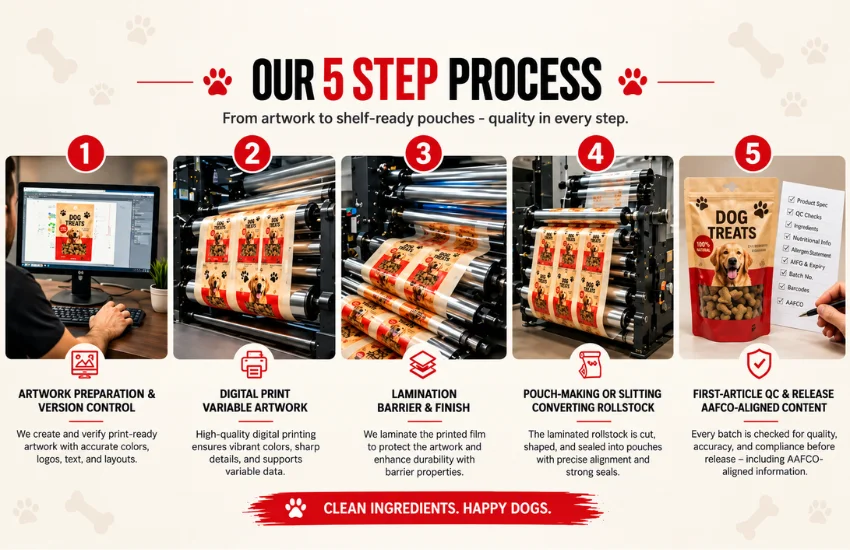
A realistic in-house production sequence for flexible dog treat bags using the ArrowJet Eco 330R:
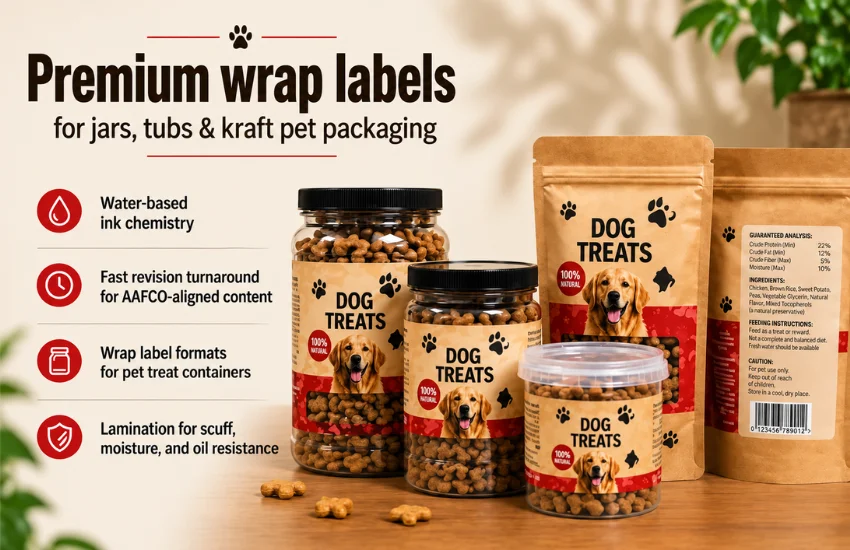
The ArrowJet Aqua 330R II is a water-based inkjet roll label press suited to wrap label production for pet treat brands using jars, PET tubs, or kraft stand-up bags as their primary container format.
Water-based chemistry is a practical preference for pet-adjacent packaging where brands prefer to avoid solvent-based inks on product-facing labels — particularly for treat products marketed on clean or natural ingredient positioning.
When a guaranteed analysis, ingredient list, feeding direction, or manufacturer contact changes, the updated label file is in production the same day approval is granted. Pre-printed wrap label inventory does not need to be scrapped — only the next print run reflects the change.
Produces roll-to-roll pressure-sensitive labels slit to finished widths matched to your label applicator. Covers jars, PET tubs, kraft stand-up bags, and bulk or foodservice container formats without the lead time or MOQ of converter-sourced labels.
Pet treat containers — particularly kraft bags and paper-based formats — require labels that resist oil migration from product contact. Laminate selection appropriate to fat and moisture content protects label legibility and adhesion through shelf life and consumer use.
The press is only part of the investment — operations infrastructure connecting artwork approval, production scheduling, QC, and release logging is what allows a small packaging team to support a growing SKU catalog without version drift or compliance slippage.
Each SKU requires a master artwork file with an explicit approval status before it can be released to print. Marketing, regulatory review, and production sign-off should be separate gates — not a single informal approval. Any AAFCO-aligned content change resets the file to pending approval status before the next print run.
In-house packaging production is most effective when print runs are scheduled just ahead of filling, not months in advance. Linking packaging production to manufacturing schedules eliminates the over-ordering dynamic that pre-printed inventory creates.
Films, laminates, label stock, zipper components, and specialty substrates must be tracked against forecast demand. Running out of a barrier film or laminate mid-production cycle creates the same supply gap that late converter orders create — just closer to the filling line.
Each production run should be traceable to the artwork file version used, the operator, the date, and the production run it supported. This documentation supports both internal QC processes and the audit trails that retailer compliance programs and future certifications may require.
Brands that invest in this operations infrastructure — not just the press — are the ones that realize the inventory, lead-time, and compliance benefits that in-house digital packaging is designed to deliver.
Common questions from pet treat brands evaluating in-house flexible packaging and label printing — covering AAFCO compliance, format selection, volume economics, and ArrowJet system differences.
SKU count and revision frequency matter more than total volume. A brand producing 50,000 units across three stable SKUs may remain well-served by a converter. A brand producing the same total volume across 20 or more SKUs — with seasonal drops, private-label work, and frequent recipe changes — typically sees the economics shift toward in-house digital once eliminated obsolete inventory and lead-time carrying costs are included. Payback windows vary by operation and should be modeled against your actual SKU mix, format requirements, and finishing investment rather than compared on per-unit print cost alone.
If you’re managing frequent label revisions, carrying obsolete pre-printed bag inventory, or losing weeks to converter lead times on seasonal and limited-edition SKUs, a structured evaluation can clarify your best path forward.
Arrow Systems works with pet treat brands to map current SKU mix, format choices between flexible pouches and labeled containers, substrate and finishing requirements, and an illustrative rollout plan using ArrowJet Eco 330R for flexible formats and/or ArrowJet Aqua 330R II for labels.
Table of Contents Pet Food Brand Label Supplier Problems: 5 Signs to Print In-House Most pet food label supplier problems are a model mismatch: flexo’s
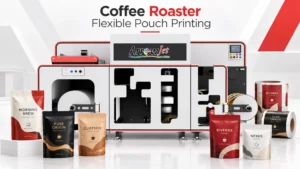
Table of Contents Coffee Roaster Flexible Pouch Printing Workflow: Roll to Bag In-house coffee pouch printing runs five stages — substrate loading, queue setup, the
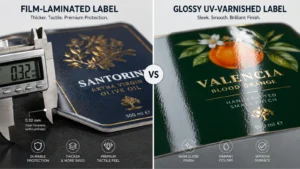
Table of Contents Overlaminate vs. Varnish Labels: How to Choose Protection Film overlaminate protects against immersion, wash-down, and solvents; UV and aqueous varnish suit retail
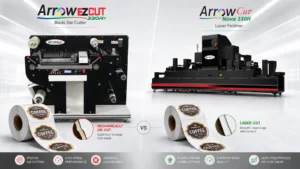
Table of Contents Blade vs. Laser Label Die Cutting: Accuracy, Speed, and Cost per Label Blade die-cutting suits simple shapes and long runs; CO2 laser
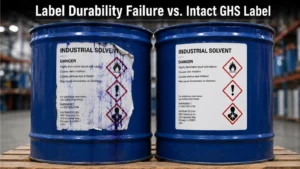
Table of Contents GHS Label Durability Failure: 4 Causes and Practical Fixes GHS label durability failures trace to four causes: aqueous ink chemistry, paper face
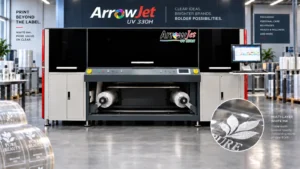
Table of Contents White Ink Clear Label Printing: When You Need It and Why White ink under clear film keeps brand color, mandatory copy, and