Pet Food Brand Label Supplier Problems: 5 Signs to Print In-House
Table of Contents Pet Food Brand Label Supplier Problems: 5 Signs to Print In-House Most pet food label supplier problems are a model mismatch: flexo’s
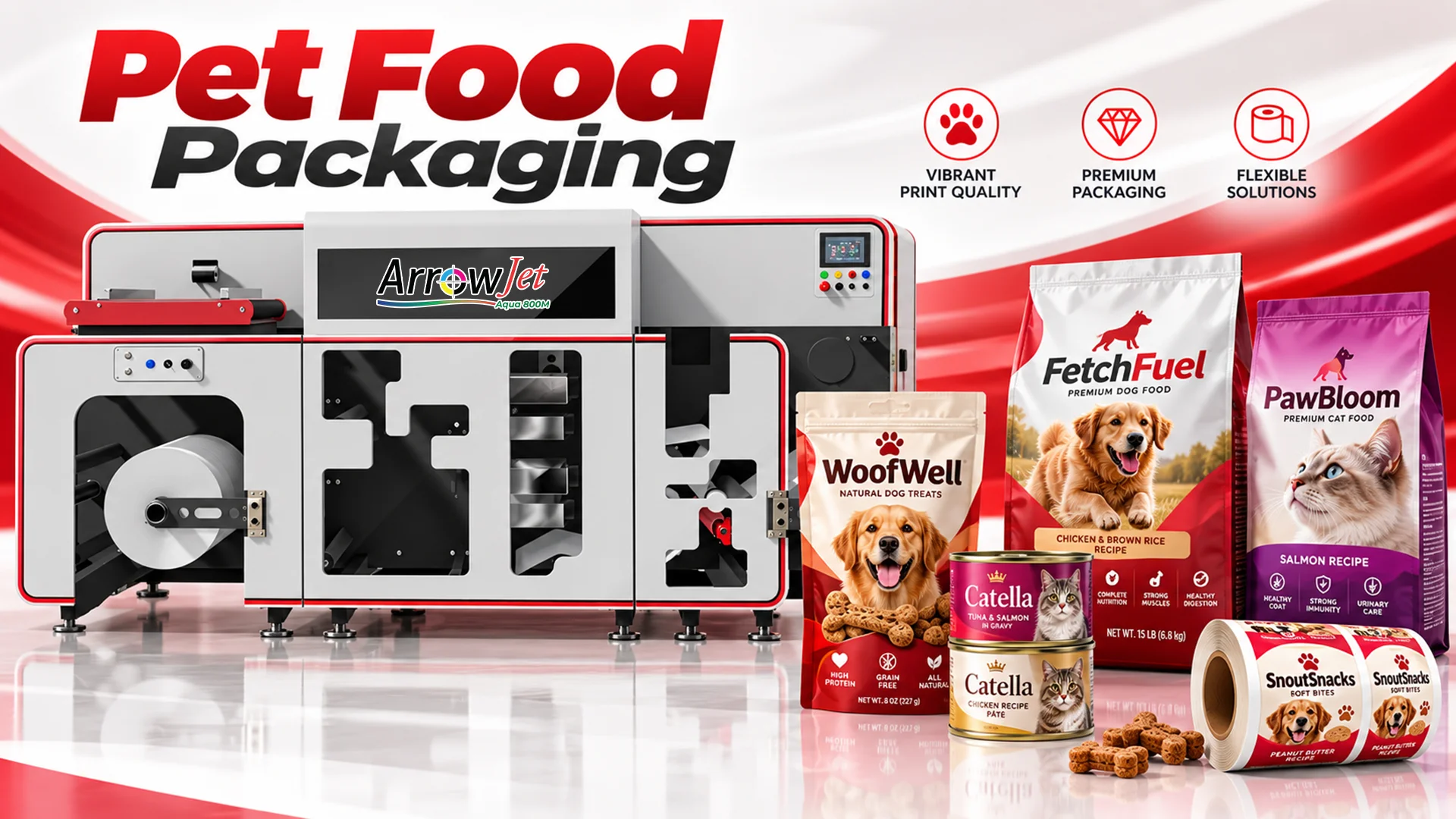
In-house digital printing gives pet food operations direct control over flexible pouches, flat-bottom bags, and roll labels — without converter MOQs, plate costs, or multi-week lead times.
A pet food packaging printer handles flexible stand-up pouches, flat-bottom bags, and pressure-sensitive roll labels for cans and jars. Digital inkjet systems — such as the ArrowJet Aqua 800M and ArrowJet Aqua 330R — eliminate plate costs, remove converter minimum order quantities, and let operations teams update AAFCO-aligned label content on the same day an artwork change is approved, rather than waiting two to four weeks for a converter reprint.
Pet food and treat brands are operating in one of the most volatile packaging environments in CPG. Flavor lineups expand every quarter. Private-label contracts demand fast turns. AAFCO-aligned label content shifts whenever a formula, supplier, or guaranteed analysis changes. And the packaging itself spans everything from stand-up kibble pouches to roll labels for canned wet food. For operations leaders trying to keep up, the right pet food packaging printer is no longer a nice-to-have — it is becoming the operational backbone that determines how fast a brand can move.
This guide is for pet brand operations and packaging leaders evaluating whether to bring pet food bag printing and custom pet food labels in-house. We cover what digital printing actually changes, where it fits across pouches and roll labels, and how to think about workflow, compliance, and scale.
Pet packaging combines high SKU complexity, strict labeling expectations, and a wide mix of substrates — requirements that consistently exceed what converter-based supply chains handle efficiently.
A printer that works for a single-SKU treat brand often breaks down when the operation grows into private label, multiple flavor families, or expanded retail distribution. The recurring requirements across growing pet food and treat operations share a consistent pattern:
Core kibble lines, limited runs, freeze-dried, toppers, functional treats, and seasonal flavors multiply quickly. Each variant needs its own artwork, barcode, and weight panel — creating a version management problem that scales directly with brand growth.
Co-mans and contract producers may run dozens of brand owners through the same lines, each with their own design standards and revision schedules. A converter-dependent operation cannot turn this work around fast enough without significant lead-time friction.
Guaranteed analysis, ingredient declarations, feeding directions, and nutritional adequacy statements change more often than most teams plan for. Every change requires a label reprint — and with converter lead times, that means weeks of exposure to non-current labels in circulation.
A single brand can need flexible stand-up pouches for kibble and treats and pressure-sensitive roll labels for cans, jars, and bone broths — sometimes in the same week. Managing two separate converter relationships compounds lead time and version control complexity.
Pet retail shelves are visually crowded. Inconsistent color across print runs or suppliers weakens brand recognition and slows retail buy-in for new SKUs and flavor launches.
Traditional supply chains handle some of this, but rarely all of it without significant inventory risk and lead-time pain.
Digital inkjet removes the plate-based economics of flexo — no minimum order quantities, no cylinder costs, no multi-week lead times — making short runs and frequent revisions economically viable.
Most flexible pet food bags and labels have historically been produced through flexo or gravure converters. That model still has a place — particularly for very high-volume, stable SKUs — but it forces tradeoffs that do not match how modern pet brands operate.
Factor | Flexo / Gravure (Converter) | Digital Inkjet (In-House) |
Minimum order quantity | High — often tens of thousands of units per SKU | Low — economical short and mid runs |
Artwork change cost | Plate or cylinder cost per version | No plates — artwork change is a file change |
Lead time | Weeks from order to delivery | Days from approved artwork to packaged product |
Obsolescence risk | High when AAFCO content or branding changes | Low — print to current demand, not MOQ math |
Variable data | Limited or cost-prohibitive | Native — batch codes, regional variants, multi-language |
Short-run flavor launches | Economically constrained | Supported by design |
Color consistency across long runs | Excellent at scale | Good; press calibration dependent |
For most growing pet brands, the question is not whether digital replaces flexo entirely — it is where digital pouch printing and digital label printing for pet food take over the work that flexo handles poorly: short runs, frequent revisions, private label, and seasonal launches.
A practical in-house pet food packaging operation covers two format families: flexible stand-up pouches and flat-bottom bags, and roll-fed pressure-sensitive labels for cans and jars.
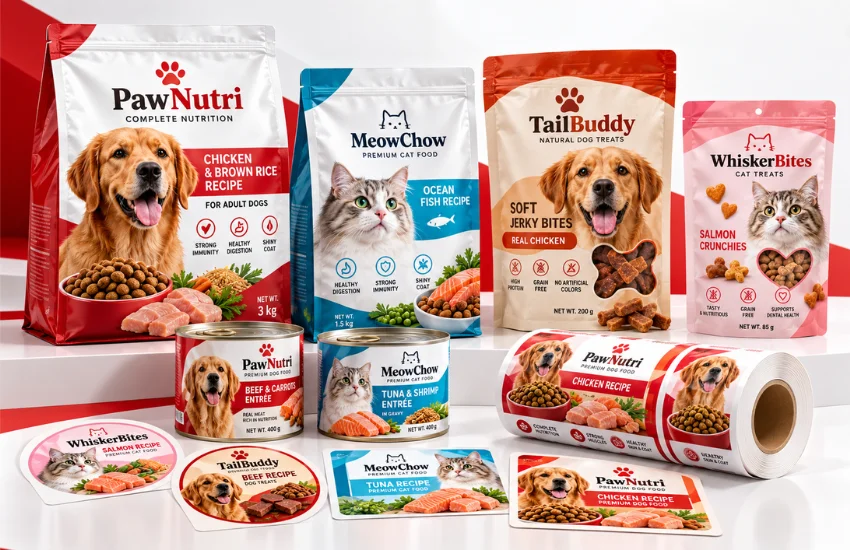
These formats run on barrier films with zippers, gussets, and resealable closures. Substrate selection drives shelf life, oxygen and moisture protection, and tactile feel — all of which affect retail performance.
Substrate, adhesive, and finish need to match shelf conditions — refrigerated topper jars, freezer storage for raw, and ambient retail exposure each impose different performance requirements on the label material.
A printer does not make a pet food label compliant — but it eliminates the operational delays that allow non-current labels to stay in circulation after a formula or regulatory change.
The following is a practical operational reference — not regulatory advice. Always verify current labeling requirements against AAFCO model regulations, applicable state feed control laws, and qualified regulatory counsel for your specific products and distribution territories.
AAFCO model regulations and state feed control requirements are interpretive and depend on product claims, ingredient sourcing, and intended species. Compliance is a regulatory and formulation function, not a printing function. What an in-house pet food packaging printer supports is the operational side of staying current:
When guaranteed analysis or feeding directions change, the revised file goes directly to the press. There is no plate cycle, no converter lead time, and no obligation to exhaust obsolete pre-printed inventory before the corrected label can ship.
Digital workflows tie a printed run to a specific approved artwork version, making reprints and compliance audits cleaner and more traceable. Each run prints from the current approved file — not from whatever roll happens to be on the shelf.
You print what is approved today, not what was approved six months ago. This is particularly important when ingredient sourcing or guaranteed analysis changes mid-production cycle, creating an immediate need to update label content without waiting on a converter.
The printer supports a compliant workflow. Your regulatory review process still owns the compliance determination.
The ArrowJet Aqua 800M is Arrow’s primary wide-web digital press for flexible pet food packaging — a 25-inch inkjet system built for stand-up pouches, flat-bottom bags, and high-output flexible production runs.
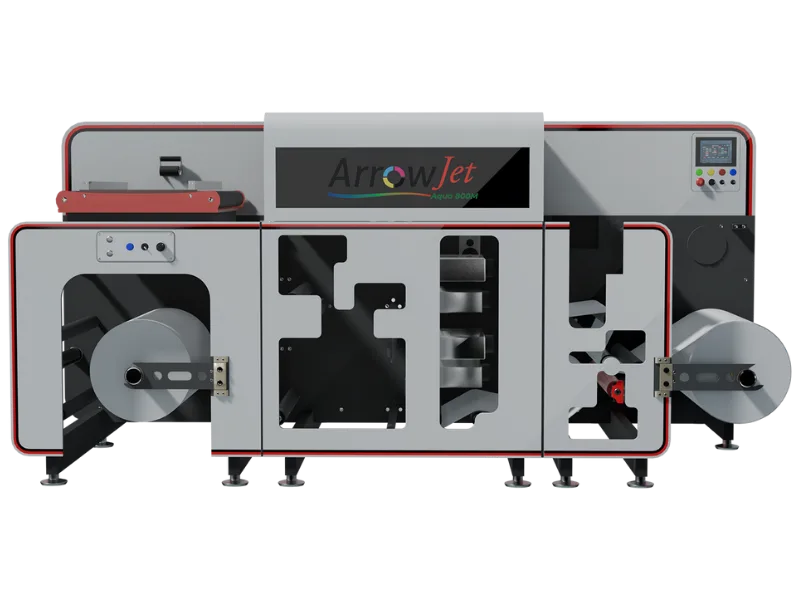
For most pet food and treat operations, flexible packaging is where the largest inventory risk and the largest lead-time pain live. The Aqua 800M addresses both by enabling short to mid runs of stand-up pouches, flat-bottom bags, treat bags, kibble bags, and topper packs on demand — at a web width that scales with mid-to-high production volumes.
Switch between recipes, weights, bag formats, and private-label brands without plate changes. The 25-inch web width accommodates a wide range of pet food pouch and bag sizes in a single production run, from single-serve treat packs to multi-pound kibble bags.
The Aqua 800M handles both pouch formats — stand-up and flat-bottom — making it a single anchor system for brands whose premium SKU lines require flat-bottom presentation alongside standard stand-up pouches. Switching between formats requires no mechanical retooling or plate changeover.
Print quantities that match near-term demand instead of hitting converter MOQs. When AAFCO content or branding changes, the cost of scrapped pre-printed flexible packaging collapses because production is demand-driven rather than inventory-driven.
Move new flavors, seasonal items, or test-market SKUs from approved artwork to packaged product in days rather than the multi-week lead times typical of converter-based flexible packaging production.
Color and print quality stay consistent across runs, which matters when multiple SKUs sit side by side on shelf or across private-label accounts with different brand standards and artwork requirements.
For brands building a real in-house capability for pet food bag printing at scale, the ArrowJet Aqua 800M is typically the anchor system in the operation.
The ArrowJet Aqua 330R is a water-based inkjet roll label press for pressure-sensitive labels on wet food cans, bone broth bottles, treat jars, and supplement containers — on demand, without plates or MOQ constraints.
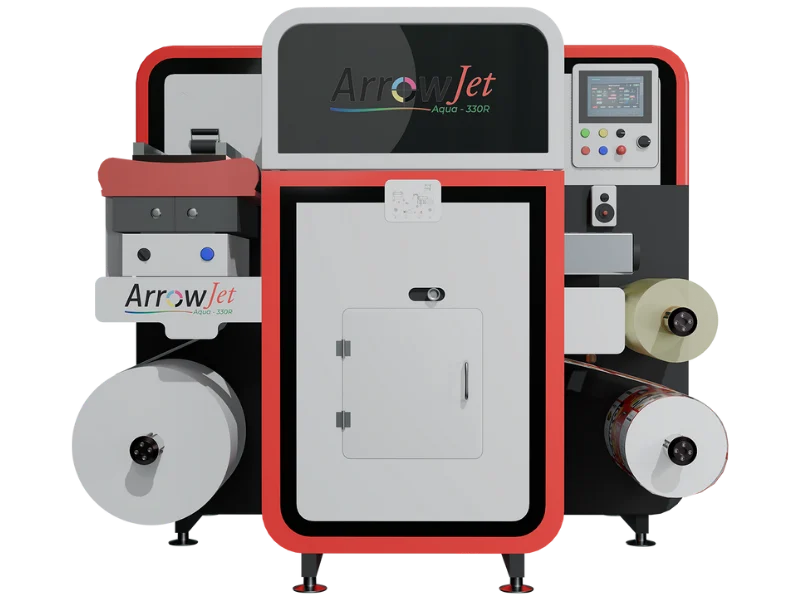
Promotional variants, seasonal can labels, and limited releases can be produced economically without the minimum order constraints of converter-based label printing. Print the exact quantity needed per production run — from a few hundred labels for a limited SKU to several thousand for a core line.
Batch coding, regional variants, multi-language labels, and version-controlled reprints are handled natively by the digital workflow without additional setup costs or plate charges per variant.
Label production scales with actual order patterns rather than pre-printed inventory levels, reducing the obsolescence risk that accompanies AAFCO-driven artwork changes on wet food, broth, and supplement jar lines.
Produce coordinated label families — wet food, broths, supplements, and seasonal variants — from a single digital workflow without juggling multiple converter relationships, lead times, and inventory positions simultaneously.
Pairing the Aqua 800M for flexible pouches and flat-bottom bags with the Aqua 330R for roll labels gives a single packaging team the ability to serve kibble, treats, wet food, and supplements from one in-house operation — without managing separate converter pipelines for each format.
The ArrowJet Eco 330R is designed for smaller pet food and treat brands moving roll label production in-house for the first time — lower entry investment, straightforward operation, and immediate elimination of converter lead times for short-run SKUs.
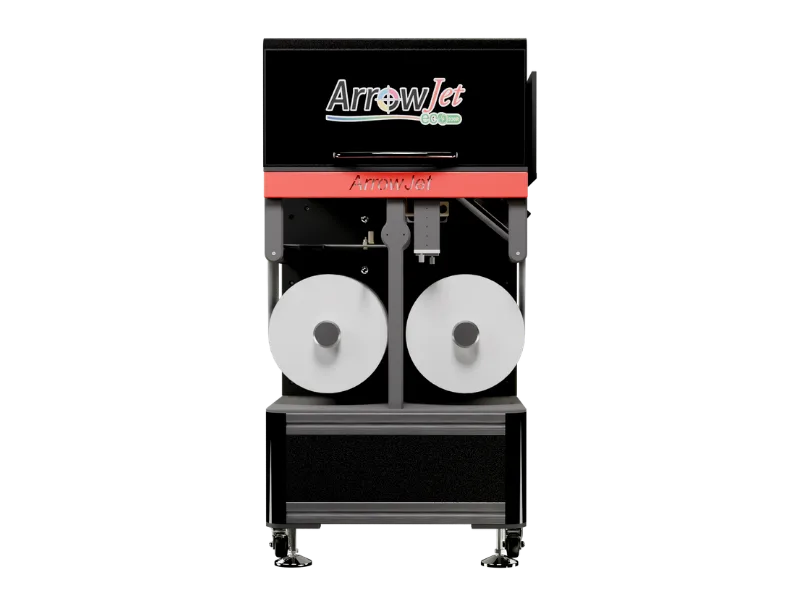
For pet food brands producing lower label volumes across a manageable SKU count, the Eco 330R provides the core capability of digital on-demand label production — no plates, no MOQ, no converter dependency — at a lower system investment than high-throughput commercial presses.
Smaller pet brands are often more exposed to pre-printed label obsolescence because they lack the volume to negotiate flexible terms with converters. The Eco 330R eliminates this exposure: updated artwork is in production the same day the change is approved, not two to four weeks later.
Brands managing 5 to 20 active label SKUs with periodic flavor additions or seasonal variants get the same no-plate, file-change flexibility of digital printing at a scale that matches actual production needs — without over-investing in press capacity ahead of volume growth.
Brands that start on the Eco 330R for roll labels can expand into flexible pouch printing as volume grows, adding an Aqua 800M without changing the workflow or quality management approach already in place for roll label production.
For pet food and treat brands at an earlier stage of growth — typically those managing under 20 active label SKUs or producing lower weekly label volumes — the Eco 330R is the practical entry point into in-house digital label production, providing immediate control over revision cycles and print scheduling without over-committing on capital.
Common questions from pet food operations and packaging leaders evaluating in-house digital printing for flexible pouches, flat-bottom bags, and roll labels.
Yes. Mid-size pet food brands are often the best fit because they have enough SKU complexity and revision frequency to feel converter MOQ pain, but not so much volume that flexo is clearly more economical. The decision usually turns on SKU count, revision frequency, and how much packaging is being scrapped today.
Digital printing shortens the time between an approved artwork update and packaged product. When guaranteed analysis or ingredient statements change, you print the new version on the next run instead of working through pre-printed inventory. The printer does not determine compliance — your regulatory review does — but it removes the operational friction that often delays updates.
Arrow Systems offers three complementary platforms: the ArrowJet Aqua 800M (25-inch wide-web) for flexible stand-up pouches and flat-bottom bags, the ArrowJet Aqua 330R for pressure-sensitive roll labels on cans, jars, and wet food containers, and the ArrowJet Eco 330R as an entry-level roll label press for smaller brands. Together they cover the full range of pet food and treat packaging from a single in-house operation.
Brands running 20 or more active SKUs, frequent flavor launches, private-label contracts, or recurring AAFCO-driven artwork changes typically find the economics work. Payback timelines vary by operation, but the calculation usually includes scrapped packaging cost, expedited reorder fees, and lead-time delays on top of equipment cost.
If your team is managing frequent AAFCO label updates, carrying obsolete pre-printed flexible packaging, or losing weeks to converter lead times on new flavor launches, a structured evaluation can clarify your best path forward.
Arrow Systems offers packaging assessments tailored to your pet food format mix, SKU count, AAFCO labeling workflow, and production volume — helping you identify which ArrowJet system fits your operation and where in-house digital makes the most sense.
Table of Contents Pet Food Brand Label Supplier Problems: 5 Signs to Print In-House Most pet food label supplier problems are a model mismatch: flexo’s
Table of Contents Coffee Roaster Flexible Pouch Printing Workflow: Roll to Bag In-house coffee pouch printing runs five stages — substrate loading, queue setup, the
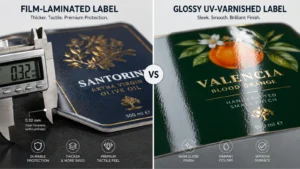
Table of Contents Overlaminate vs. Varnish Labels: How to Choose Protection Film overlaminate protects against immersion, wash-down, and solvents; UV and aqueous varnish suit retail
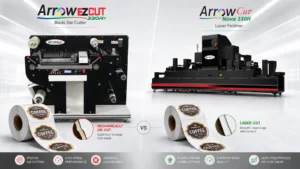
Table of Contents Blade vs. Laser Label Die Cutting: Accuracy, Speed, and Cost per Label Blade die-cutting suits simple shapes and long runs; CO2 laser
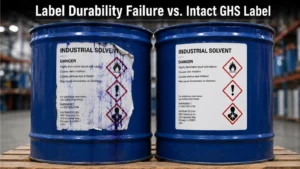
Table of Contents GHS Label Durability Failure: 4 Causes and Practical Fixes GHS label durability failures trace to four causes: aqueous ink chemistry, paper face
Table of Contents White Ink Clear Label Printing: When You Need It and Why White ink under clear film keeps brand color, mandatory copy, and