Medical Device Labels: UDI Requirements, FDA 21 CFR Part 801, and Printing Considerations
Table of Contents Medical Device Labels: UDI Requirements, FDA 21 CFR Part 801, and Printing Considerations FDA 21 CFR Part 801 and the UDI rule
A digital label cutter is capable of providing precise and finely cut labels with the click of a button. The information related to the layout, creases, and cuts of labels is communicated through electronic signals.
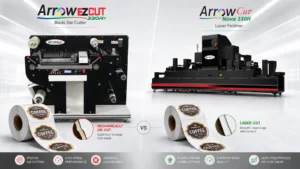
Laser cutting has gained popularity rapidly as it has proven to be a viable option for finishing. This method utilizes a high-speed laser for cutting label. The laser die-cutting system consists of 2 elements; a laser source and scan head. The scan head has mirrors that are used to trace the desired shape. These mirrors are placed in a way that redirects the light to the cutting surface. A great thing about this system is that it requires no contact with the material for cutting it. In this article, we have highlighted the benefits of the laser cutter.
One of the top benefits of digital label die-cutter is that it is extremely fast. The Galvanometric system in Arrow Cut Nova 330R enables the laser beam to move quickly while keeping the focus on the cutting surface. The laser die-cutter has no limitations when it comes to design. You can easily cut any design irrespective of the size and shape of the object.
Another benefit of this laser cutter is that it is great for cutting labels on various materials. Some of the materials include:
A laser die-cutter may be pricier than other options such as rotary or knife die cutters, however, a laser finisher will last for a longer period of time. There is no mold or knife that will become dull and need to be sharpened or replaced. You won’t need different molds for cutting various designs. Moreover, a laser cutter will help you save on production costs and replacement costs, as well as offer a faster turnaround time for your customers. A laser system will not need any maintenance which will save your company money.

Another advantage of laser die-cutters, the Arrow Cut Nova 330R from Arrow Product line in particular, is that they are user-friendly. In comparison to blade-cutting options, the laser is simple to use. With a little training, you can become a master of die-cutting in no time. The laser cutting uses a slim laser beam that will not lead to the wastage of materials.
The laser die-cutting technique is versatile as it enables you to produce labels in huge quantities in a single process. The laser can readjust for quick operations and give you accurately cut labels. You can also perform specialty functions like marking, hatching, and perforation at the same time as the cutting function, giving you added capacity and the ability to offer more to your customers.
All in all, the laser technology from Arrow Cut Nova 330R is the best post-processing technology for cutting labels. The Arrow Cut Nova 330R is the perfect solution for smaller companies to transition away from blade and rotary cutters. It gives you room for increased capacity and faster turn-around times. The cutting software is integrated into Adobe Illustrator, making it extremely user friendly and easy to learn Laser die-cutting a great way to boost productivity by increasing your die-cutting speeds and versatility. It is an amazing cutting system that is faster than any blade cutter and easier to use than any semi-rotary system on the market. Arrow Cut Nova 330R is an ideal laser-cutter for labels that provides quality labels. You can take advantage of this system as it will save your time and cost.
For more information visit our website HERE!

Table of Contents Medical Device Labels: UDI Requirements, FDA 21 CFR Part 801, and Printing Considerations FDA 21 CFR Part 801 and the UDI rule

Table of Contents USDA Food Label Guidelines: Six Common FSIS Labeling Mistakes to Avoid USDA FSIS food label approval is blocked most often by six

Table of Contents Beauty Product Labels: INCI Names, Formatting & FDA Rules Beauty product labels must list every ingredient by INCI name in descending order

Table of Contents GHS Label Printing: HazCom 2012 Compliance for Chemical Manufacturers OSHA HazCom 2012 requires six GHS label elements on every shipped chemical container

Table of Contents Cosmetic Label Printing: 6 Tips for Materials, Design, In-House Production, and Finishing The most important decisions in cosmetic label printing are substrate

Table of Contents Specialty Coffee Packaging Trends Roasters Are Printing in 2026 In 2026, specialty coffee packaging tells the brand story that a brochure once