



Best Color Label Printers 2026
Table of Contents Best Color Label Printers 2026 – Buyer’s Guide & Top Picks Choosing the best color label printer in 2026 has become more

Custom Mylar Bags Market Will Hit $33.2 Billion by 2028 — Here’s How to Win Now.
The demand for custom Mylar bags has exploded. Consumer product brands across food, snacks, nutraceuticals, cosmetics, and cannabis are shifting from rigid packaging to flexible, lightweight, and customizable Mylar pouches. According to industry reports, over 72% of brands say premium printed pouches directly influence customer purchase decisions, and nearly 65% of converters are upgrading their digital presses to accommodate short-run and high-mix Mylar jobs in 2026.
If you’re a brand or converter, mastering custom Mylar bag printing is now a competitive necessity. But Mylar isn’t like paper or BOPP. It requires the right substrates, ink technology, curing system, and finishing workflow for durable, food-safe, and compliant results.
This guide breaks down everything you need to know — including what Mylar is, why it dominates the flexible packaging world, and how to print custom Mylar bags with the ArrowJet Aqua 800M, the leading 2026 digital solution for Mylar and pouch applications.
Mylar is a biaxially-oriented polyester film, technically known as BoPET (Biaxially Oriented Polyethylene Terephthalate). It was originally trademarked by DuPont and has become synonymous with high-barrier, heat-resistant, and durable flexible packaging.
Property | Why It Matters |
High Barrier Protection | Extends shelf life; resists oxygen, light, and moisture. |
Thermal Stability | Great for heat-sealing and stand-up pouch manufacturing. |
Strength & Puncture Resistance | Withstands shipping and retail handling. |
Lightweight | Reduces logistics costs. |
Printable Surface | Compatible with advanced inkjet and digital printing systems. |
As consumer expectations rise and brands shift toward flexible, sustainable solutions, Mylar packaging has quickly become the gold standard for 2026. Its unique combination of durability, barrier protection, printability, and customization makes it the preferred choice for both established brands and fast-growing micro-businesses.
With sustainability becoming a core purchasing factor, Mylar stands out for its lightweight structure, reduced material waste, and recyclability options. Brands benefit from lower shipping costs, smaller carbon footprints, and packaging that supports modern eco-friendly initiatives—all while maintaining exceptional product protection.
Today’s consumers expect personalized, limited-edition, and niche product variations. Mylar bags make this possible thanks to their excellent print compatibility and cost-effective short-run production, especially with digital presses like the ArrowJet series. Whether it’s seasonal SKUs, influencer collaborations, private-label products, or subscription box items, Mylar allows brands to move fast without compromising quality.
From powders and snacks to supplements, cosmetics, coffee, and liquids, Mylar’s superior barrier properties protect against moisture, oxygen, UV exposure, and contamination. This extends shelf life, keeps products fresh, and maintains brand integrity across diverse industries, F&B, nutraceuticals, beauty, and beyond.
Direct-to-consumer businesses require packaging that is lightweight, protective, aesthetically premium, and quick to produce. Mylar checks every box. It ships well, holds its shape, and offers a large printable surface for bold branding. With fast digital printing, D2C brands can launch products in days instead of months.
Because of these advantages, Mylar bags have become the preferred solution for CPG brands, cannabis companies, private-label manufacturers, boutique businesses, and micro-brands. They deliver a powerful combination of:
In 2026 and beyond, Mylar continues to lead because it supports what the modern market demands: speed, sustainability, freshness, and flawless branding.
Consumers buy with their eyes—and Mylar delivers unmatched visual impact.
In competitive retail and e-commerce environments, Mylar packaging helps brands differentiate instantly.
Industries such as nutraceuticals, food, beverages, and cannabis now face stricter labeling and packaging compliance than ever before.
Brands need packaging that supports:
Custom Mylar bags—combined with pigment-based digital printing—deliver long-lasting, high-clarity labels that withstand moisture, heat, and handling.
Below is the complete professional workflow used by converters and packaging manufacturers producing custom Mylar bags at scale. Whether you’re printing for food, nutraceuticals, cosmetics, or cannabis, this guide covers the essential steps for achieving premium, compliant, and durable Mylar packaging.
Selecting the correct Mylar film is the foundation of high-quality pouch production. Each substrate offers unique barrier properties, print characteristics, and sealing performance depending on the product being packaged.
Converters using the ArrowJet Aqua 800M benefit greatly from its ability to run a wide variety of Mylar-based films. Its advanced pigment inkjet chemistry and precise media transport system are engineered specifically to handle the challenges of flexible packaging substrates, ensuring clean edges, accurate ink laydown, and exceptional color consistency.
Proper artwork preparation ensures accurate color, sharp detail, and correct alignment during pouch forming. Files should be created at high resolution with appropriate bleed allowances and clearly marked seal areas, gussets, zippers, and tear notches.
Because Mylar films can stretch slightly during forming, using the converter’s exact pouch template is essential to maintain design accuracy.
Printing is performed on the flat Mylar web before lamination. Modern digital presses such as the ArrowJet Aqua 800M are engineered to handle PET and MET-PET films with precise ink laydown, high resolution, and consistent color output.
Pigment-based aqueous inks are preferred for Mylar because they provide excellent adhesion, durability, and compatibility with downstream lamination and heat sealing.
Lamination protects the printed layer and provides the final barrier and mechanical properties required for packaging. Depending on the application, common structures include PET/PE for general use, MET-PET/PE for high-barrier pouches, and PET/AL/PE for long shelf-life products.
Lamination enhances moisture and oxygen resistance, improves puncture strength, and protects graphics from abrasion during filling, transport, and retail handling.
After lamination, the web is slit into precise roll widths suitable for pouch-making equipment. Accurate slitting ensures clean edges, stable rolls, and consistent alignment during conversion, reducing waste and improving seal integrity.
The laminated rolls are then converted into finished Mylar bags using pouch-making machines. This stage includes folding, heat sealing, gusset formation, zipper or valve insertion, and tear-notch creation. Stable laminates and heat-resistant inks are critical at this stage to maintain seal strength and compliance.
Optional finishing features enhance branding and functionality. These may include matte or gloss effects, spot varnish, embossing, custom window shapes, QR codes, and variable data such as batch numbers. Digital printing enables these enhancements even in short runs.
Before shipment, finished Mylar bags undergo quality checks including seal integrity testing, barrier performance verification, durability testing, color consistency checks, and regulatory label verification. This ensures the packaging meets food safety, labeling, and industry standards.
Approved bags are packed and delivered to brands. Many converters now offer on-demand Mylar printing, allowing brands to order smaller quantities with faster turnaround, supporting agile product launches and inventory control.
Digital printing eliminates plate costs, reduces setup time, and enables rapid production of customized Mylar packaging. It is particularly cost-effective for short to medium runs and supports personalization, variable data, and faster time-to-market.
The ArrowJet Aqua 800M is purpose-built for wide-web flexible packaging, including PET, MET-PET, and multilayer Mylar films. Its pigment-based ink system is designed for food-safe applications and delivers strong adhesion, resistance to heat and abrasion, and compatibility with lamination and pouch forming.
For converters entering or expanding in the Mylar packaging market, the system offers production-level speeds, low operating costs, and reliable performance across a wide range of pouch formats.
What is Mylar made of?
Mylar is made from biaxially oriented polyester film (BoPET), known for its strength, clarity, and high barrier protection.
Can you print directly on Mylar bags?
Yes. Digital pigment inkjet systems designed for PET and MET-PET films can print directly on Mylar before lamination.
Are Mylar bags food-safe?
They are food-safe when printed with compliant inks and laminated using approved materials.
What is the best printer for custom Mylar bags in 2026?
Production-level digital systems like the ArrowJet Aqua 800M are designed specifically for Mylar and flexible packaging applications.
Table of Contents Best Color Label Printers 2026 – Buyer’s Guide & Top Picks Choosing the best color label printer in 2026 has become more
Table of Contents How to Print Custom Mylar Bags in 2026 | Full Guide for Brands & Converters Custom Mylar Bags Market Will Hit $33.2
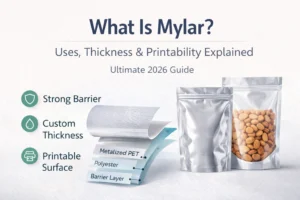
Table of Contents What Is Mylar? Uses, Thickness & Printability Explained (Ultimate 2026 Guide) Mylar bags are everywhere today from coffee packaging to pet treats,
Table of Contents How to Ensure Food-Safe Printing for Pouches & Bags (2026 Guide for Brands & Converters) Food brands today face more pressure than
Table of Contents Mylar Bags for Long-Term Food Storage: The Complete 2026 Guide for Survivalists, Food Brands & Home Preppers When it comes to protecting
Table of Contents Arrow Systems, Inc. Announces the Launch of the ArrowJet MTS-48 A Breakthrough in Membrane Switch & Industrial Overlay Printing Arrow Systems, Inc.