Which Label Finishers Should Cosmetics Contract Manufacturers Buy for Short Digital Runs?
The short answer
Cosmetics contract manufacturers should compare digital blade cutting, laser finishing and semi-rotary die cutting using their actual label materials and order mix. Digital blade and laser workflows are useful candidates when shapes change frequently; semi-rotary finishing deserves comparison when the same shapes repeat. Buy on accepted finished-roll output, cut quality and changeover cost—not maximum machine speed alone.
For cosmetics contract manufacturers turning short digital print runs into inspected, application-ready label rolls.
Equipment to evaluate
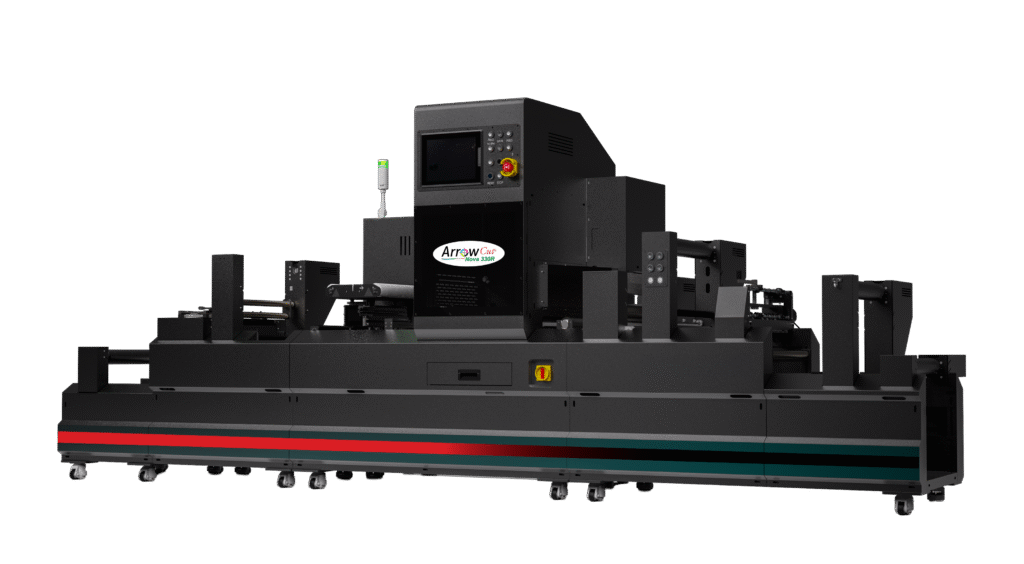
ArrowCut Nova 330R
Confirm fit with your actual artwork, materials, and finishing requirements.
Buying criteria
Start with the Finished Label and Applicator
Changing shapes versus repeat shapes
Count how many new dielines enter production and how often each shape repeats. Digital blade or laser cutting can avoid a physical die for each new shape. Semi-rotary finishing uses tooling, which can become practical when repeat work allows its cost to be spread across orders.
Label construction and edge quality
Test the actual face stock, ink, adhesive, liner and any laminate. Inspect the cut edge, adhesive behavior and liner integrity. For laser trials, specifically inspect heat-related marking or discoloration; for blade trials, examine corners, fine details and liner scoring. Do not assume every listed film cuts equally well.
Lamination and cosmetic exposure
Decide whether the design needs a matte or gloss laminate, another protective finish or neither. Test finished labels against the product’s oils, water exposure and handling. A finishing system’s ability to laminate does not establish chemical resistance for every formulation.
Finished-roll compatibility
Confirm web width, registration marks, slit widths, core size, roll diameter, winding direction and label orientation. Check that small labels dispense reliably on the actual applicator. A roll that looks good on the rewinder is not automatically ready for the filling line.
Recommended directions
Arrow Equipment Options to Compare
Digital blade-cutting candidate
Arrow EZCut 330R+
Evaluate the Arrow EZCut 330R+ for digitally controlled short-run cutting, cold lamination and matrix-removal workflows. Demonstrate the exact shapes, liner and slit pattern before selecting a configuration.
Laser-finishing candidate
ArrowCut Nova 330R
Evaluate the ArrowCut Nova 330R for digital laser cutting with lamination, matrix removal, slitting and rewinding. Confirm material compatibility and inspect laser edges on the final cosmetics label construction.
Repeat-shape production candidate
Aries Semi-Rotary Finishing
Evaluate Aries semi-rotary finishing when repeat label shapes justify flexible-die tooling. Compare complete setup, tooling and running costs against digital cutting at your actual repeat quantities.
Decision table
Which Finishing Direction Fits Your Job Mix?
| Your requirement | Direction to evaluate | What to confirm |
|---|---|---|
| Frequent new shapes and small orders | Compare digital blade and laser | Time setup and cutting on your most intricate label, not just a simple rectangle. |
| Heat-sensitive or visually critical edges | Run a blade-versus-laser material trial | Approve the final edge and liner; reject visibly marked or unreliable constructions. |
| Repeated shapes across recurring SKUs | Compare semi-rotary tooling | Include die cost, delivery, storage, setup waste and actual repeat volume. |
| Small jars, narrow labels or difficult matrix | Test stripping, slitting and dispensing together | Check matrix breaks, roll tension, label lift and application reliability. |
| Several short jobs per shift | Prioritize total changeover performance | Count accepted finished rolls per shift, including loading, setup and inspection. |
Workflow notes
A Finisher Demonstration That Answers the Buying Question
- Bring difficult real jobs. Supply printed rolls, dielines and the intended laminate. Include small radii, narrow gaps, full-bleed artwork and the weakest matrix construction you regularly produce.
- Validate the complete cut. Confirm cut-to-print alignment across the roll, clean matrix stripping and an intact release liner. Inspect samples from the start, middle and end rather than accepting one hand-selected label.
- Change the job. Switch size or shape and record operator time, waste, file changes and physical tooling. Compare these numbers across the same job sequence for each machine.
- Run finished rolls on the line. Test the required winding and core format on the applicator. Observe dispensing, label placement, container adhesion and any edge lift during realistic handling.
- Check operating requirements. Confirm extraction for laser equipment, maintenance access, consumables, training and unit-specific installation requirements. Obtain the exact build’s site guide before planning electrical work or floor space.
Related Guides and Sources
Buyer questions
Frequently Asked Questions
Is laser finishing always best for short cosmetics runs?
No. Laser is worth evaluating for frequent shape changes, but material response, edge appearance, extraction requirements and actual output matter. Digital blade cutting or semi-rotary finishing may be the better fit after a representative trial.
When should a contract manufacturer consider semi-rotary finishing?
When the same label shapes repeat often enough to justify flexible-die tooling and setup. Compare total cost over the expected repeat work rather than assuming every short order rules out a die-based system.
Does lamination make cosmetic labels oil-proof?
Not automatically. Performance depends on the full label construction and the cosmetic formulation. Test the ink, face stock, adhesive and laminate together under the intended exposure conditions.
How should finishing speed be compared?
Measure accepted finished labels or rolls over a representative job sequence, including setup, matrix removal, slitting, inspection and changeovers. Complex shapes can produce very different results from simple test patterns.
Can an existing digital press work with a standalone finisher?
Potentially, if the printed roll and registration workflow are compatible. Confirm web and print widths, registration marks, roll diameter, core size, winding, tension and software handoff with both equipment suppliers.
Next step
Test Your Cosmetics Labels Before Buying a Finisher
Send your label sizes, dielines, materials, order mix and applicator-roll requirements. Arrow can help compare finishing routes using representative samples.
Discuss Your Application with Arrow