How Do Mid-Sized Packaging Printers Evaluate White-Label Printing Solutions for Cosmetics Clients?
The short answer
Mid-sized packaging printers should evaluate white-label cosmetics printing as a complete multi-brand production service: approved artwork, repeatable color, qualified materials, fast changeovers, finishing capacity and cost per accepted finished label. Here, white-label means printing for a client’s brand—not manufacturing the cosmetic formula. Start with representative client jobs and compare measured workflow results before selecting equipment.
A practical evaluation framework for packaging printers producing labels and packaging under their cosmetics clients’ brands.
Equipment to evaluate
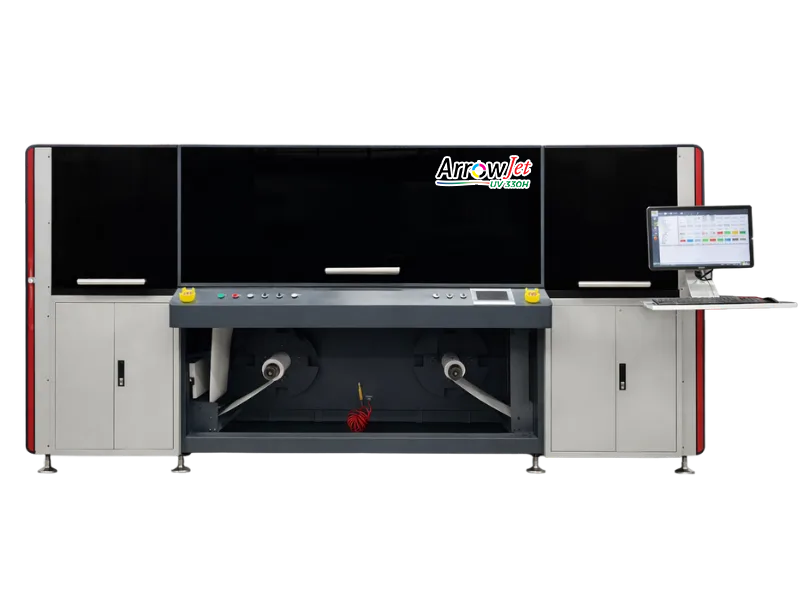
ArrowJet UV 330H
Confirm fit with your actual artwork, materials, and finishing requirements.
Buying criteria
Evaluate the Service Before Choosing the Press
Define what you will deliver
Separate finished bottle and jar labels from printed pouch film, cartons and direct-to-container decoration. Each needs a different production route. Decide whether your service ends with printed rolls, application-ready labels or converted packaging; do not quote a finished package when only printing is included.
Control each client’s brand assets
Keep approved artwork, color references, dielines and revision records separated by client and SKU. Agree who approves text, barcodes and the final proof. A fast press cannot prevent the cost of printing an obsolete formula panel or mixing two brands’ files.
Qualify appearance and durability together
Run the actual paper or film, adhesive and protective finish. Check small text, gradients and brand colors alongside rubbing, moisture and exposure to the intended cosmetic formulation. Clear or metallic materials may require white ink; demonstrate the proposed ink configuration rather than assuming CMYK alone will reproduce the design.
Measure the whole production shift
Compare artwork preparation, setup waste, printing, lamination, cutting, slitting, inspection and packing. Include scheduled cleaning, consumables, service and operator time. For many small orders, changeovers and finishing can determine capacity more than the advertised print speed.
Recommended directions
Arrow Equipment Options to Compare
Qualified CMYK roll-label jobs
ArrowJet Aqua 330R II
Evaluate the Aqua 330R II for short-to-medium roll-label work when the approved stock and artwork suit water-based pigment CMYK. Include downstream finishing in the trial.
Specialty label and sample work
ArrowJet UV 330H
Evaluate the UV 330H when client artwork calls for white ink, varnish or a mix of roll and flatbed applications. Confirm the supplied configuration against the intended materials.
Application-ready label rolls
Digital Label Finishing
Choose finishing alongside the press. Compare digital cutting and semi-rotary approaches using the client’s shape variety, repeat orders and applicator-roll requirements.
Decision table
Turn Client Requirements into an Acceptance Test
| Your requirement | Direction to evaluate | What to confirm |
|---|---|---|
| Many brands, frequent artwork changes | Controlled digital job library | Recall the correct approved file, material and color setup for a repeat order. |
| Premium clear or metallic labels | White-ink-capable workflow | Inspect opacity, registration and appearance on the actual container. |
| Many short jobs with new shapes | Digital finishing evaluation | Measure file preparation, changeover waste, edge quality and finished-roll output. |
| Repeated shapes and growing repeat volume | Compare semi-rotary finishing | Include die purchase, storage and changeover costs in the comparison. |
| Pouches or cartons added to the service | Separate converting plan | Verify material preparation and all cutting, laminating, forming or gluing steps. |
Workflow notes
Run a Multi-Brand Production Trial
- Build a representative job set. Include a simple repeat label, a color-critical premium design and a short order with several variants. Add the most difficult approved stock and smallest text you expect to sell.
- Agree pass/fail criteria before printing. Set acceptable color, readability, cut registration, application and appearance criteria with the client. Test finished labels on the real bottle, jar or tube, including the intended storage and use conditions.
- Time the complete job. Record operator touch time, setup meters, accepted labels and every finishing stage. Calculate cost per accepted finished label as total job cost divided by accepted quantity, not the printed count before waste.
- Test the reorder. Recall the saved setup, print a second batch and compare it with the signed reference. Verify traceability and client separation as well as visual consistency.
- Define the service boundary. Document proof approval, material substitutions, minimum orders, lead times and responsibility for label copy. Establish a practical support and contingency plan before committing customer deadlines.
Related Guides and Sources
Buyer questions
Frequently Asked Questions
Does white-label printing mean manufacturing cosmetics?
Not in this guide. It means providing printing under the customer’s brand. Formula development, filling and cosmetic manufacturing are separate services and should not be implied by a printing quote.
Should every cosmetics client use the same press and material?
No. Standardizing qualified materials can simplify production, but clear films, metallic designs, container shapes and product exposure may require different inks, adhesives or finishes. Qualify the complete construction for each application.
How should a printer compare operating costs?
Use total job cost divided by accepted finished labels. Include setup waste, ink, material, finishing, tooling where applicable, operator time and appropriate equipment and service allocations. Compare representative order sizes rather than one ideal long run.
What is the most useful equipment demonstration?
A complete trial using your client artwork and materials, followed through finishing, inspection and application. Include a repeat job so color recall and saved setup performance can be assessed.
Can equipment alone ensure label compliance?
No. The appropriate party must approve product information and artwork for the intended market. Printing equipment reproduces files; it does not independently validate regulatory content or turn an unapproved label into a compliant one.
Next step
Plan Your Cosmetics Printing Service
Share the client job mix, order sizes, materials, premium effects and finishing requirements. Arrow can help scope a sample trial and equipment comparison.
Discuss Your Application with Arrow