Nutraceutical Label Printing: The Ultimate 2026 Guide to FDA Dietary Supplement Labeling Compliance
Table of Contents
- What Is Nutraceutical Label Printing and Why Compliance Matters
- DSHEA Compliance: The Foundation of Dietary Supplement Labeling
- FDA Dietary Supplement Labeling Requirements
- Supplement Facts Panel Requirements
- Common Nutraceutical Label Compliance Mistakes
- Nutraceutical Label Printing Solutions: The ArrowJet Aqua 330R
- Variable Data for Nutraceutical Labels
- Implementation Roadmap for FDA-Compliant Labels
- Nutraceutical Labeling FAQ
- Key Takeaways
- Conclusion
What Is Nutraceutical Label Printing and Why Compliance Matters
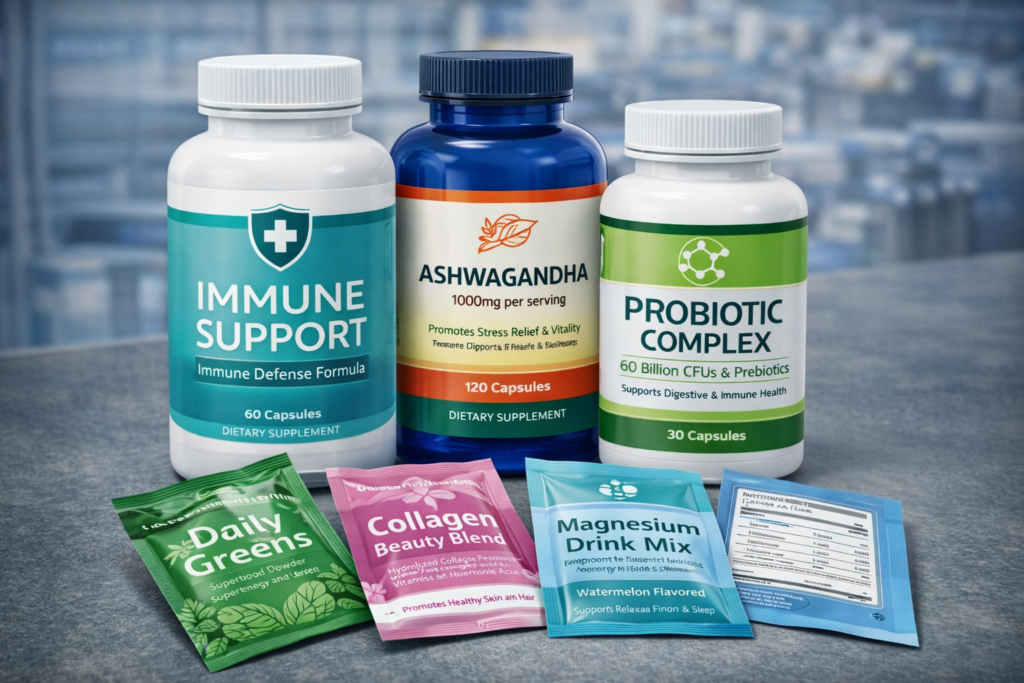
Nutraceutical label printing is the specialized process of creating FDA-compliant labels for dietary supplements, vitamins, and nutritional products. Understanding nutraceutical label printing requirements and FDA dietary supplement labeling regulations isn’t just about avoiding regulatory issues—it’s about building consumer trust, protecting your brand, and ensuring your products can be sold nationwide.
The dietary supplement industry operates at the intersection of food and pharmaceuticals. Regulated as food under the Dietary Supplement Health and Education Act of 1994 (DSHEA), supplements have nutraceutical label printing requirements that share similarities with drug standards. This unique positioning creates a complex compliance environment where manufacturers must navigate FDA regulations, FTC advertising guidelines, and state-level requirements simultaneously.
Unlike conventional food products, dietary supplements face heightened scrutiny because consumers use them for health benefits. The FDA requires specific disclosure formats, prohibits certain claims, and mandates precise ingredient nomenclature in nutraceutical label printing. Non-compliance isn’t just a regulatory risk—it can result in product seizures, warning letters, and significant brand damage.
This comprehensive guide breaks down the essential FDA dietary supplement labeling requirements, provides actionable compliance checklists for nutraceutical label printing, and explains how digital nutraceutical label printing solutions like the ArrowJet Aqua 330R enable supplement brands to maintain compliance while responding quickly to regulatory changes.
DSHEA Compliance: The Foundation of Dietary Supplement Labeling
What Is DSHEA?
The Dietary Supplement Health and Education Act of 1994 provides the regulatory framework for dietary supplements in the United States. Under DSHEA compliance requirements:
- Supplements are regulated as food, not drugs
- Manufacturers are responsible for ensuring safety before marketing
- FDA oversees dietary supplement label regulations and post-market surveillance
- Structure/function claims are permitted with disclosures
- Disease claims require drug approval (and are prohibited for supplements)
FDA’s Role in Supplement Labeling
The FDA doesn’t approve supplement labels before products hit the market. Instead, they conduct post-market surveillance, inspect facilities, and review labels during routine inspections. This means nutraceutical label compliance is the manufacturer’s responsibility—and mistakes can be costly.
Key FDA Oversight Areas:
- Label accuracy and completeness
- Prohibited disease claims
- Adverse event reporting
- Good Manufacturing Practices (GMP) compliance
- Ingredient safety substantiation
FDA Dietary Supplement Labeling Requirements
Required Label Elements for Dietary Supplements
Every FDA-compliant dietary supplement label must include these five essential elements:
| Element | Requirement | Common Mistakes |
|---|---|---|
| Statement of Identity | Product name + “Dietary Supplement” | Forgetting the supplement declaration |
| Net Quantity | Weight, volume, or unit count | Wrong measurement format |
| Supplement Facts Panel | Detailed nutrient breakdown | Improper formatting, missing nutrients |
| Ingredient List | All ingredients in descending order | Botanical name omissions |
| Manufacturer Info | Name, address, contact | Missing required contact details |
Structure/Function Claims vs. Disease Claims
Understanding the difference is critical for dietary supplement label regulations:
✅ Permitted Structure/Function Claims:
- “Supports immune health”
- “Promotes cardiovascular function”
- “Helps maintain healthy joints”
❌ Prohibited Disease Claims (Require Drug Approval):
- “Prevents cancer”
- “Treats diabetes”
- “Cures arthritis”
Required Disclaimer: “These statements have not been evaluated by the FDA. This product is not intended to diagnose, treat, cure, or prevent any disease.”
Supplement Facts Panel Requirements
The 7 Essential Components
The supplement facts panel requirements are specific and non-negotiable:
- Serving Size – Must be realistic and customary
- Servings Per Container – Accurate count
- Calories – If present (usually 0 for supplements)
- Macronutrients – Total fat, carbs, protein if significant amounts
- Dietary Ingredients – Listed with amount and %DV when established
- Other Ingredients – Binders, fillers, excipients
- Daily Value Footnote – Reference to 2,000 calorie diet when needed
Formatting Rules for Supplement Facts Panels
Font Requirements:
- All text must be legible (minimum 6pt)
- “Supplement Facts” must be the largest text in the panel
- Amounts and %DV must be clearly aligned
- Hairlines can separate sections but aren’t required
Layout Standards:
- Calories must appear first (if present)
- Dietary ingredients in descending order by weight
- Botanicals listed by common and Latin names
- %DV mandatory when RDIs are established
Common Nutraceutical Label Compliance Mistakes
Mistake #1: Improper Supplement Facts Formatting
Many nutraceutical label printing projects fail because the supplement facts panel doesn’t meet FDA layout requirements. Common errors include:
- Wrong font sizes
- Improper indentation
- Missing daily values
- Incorrect nutrient ordering
Mistake #2: Unapproved Health Claims
Making disease claims or exaggerating structure/function benefits can trigger FDA warning letters. The best FDA dietary supplement labeling practice is conservative claims backed by substantiation.
Mistake #3: Missing Botanical Nomenclature
FDA requires both common names and Latin binomials for botanical ingredients. Listing only “green tea extract” without Camellia sinensis is a compliance violation.
Mistake #4: Incomplete Manufacturer Information
Labels must include:
- Manufacturer or distributor name
- Complete street address (or city/state/zip if listed in phone directory)
- Working contact information
Mistake #5: Wrong Label Material for Product Type
Supplements have specific nutraceutical label printing durability requirements:
- Moisture resistance for refrigerated products
- Oil resistance for softgels
- UV stability for products in clear containers
Nutraceutical Label Printing Solutions: The ArrowJet Aqua 330R
Why Digital Label Printing for Supplements?
The best nutraceutical label printing approach combines regulatory compliance with operational flexibility. Digital printing offers:
- Variable data capability – Batch codes, lot numbers, expiration dates
- Short-run economics – No minimum orders, perfect for SKUs
- Quick turnaround – Same-day production for urgent changes
- Regulatory agility – Update labels immediately when FDA guidance changes
The ArrowJet Aqua 330R for Supplement Labels
The ArrowJet Aqua 330R is the ideal nutraceutical label printing solution because it offers:
- Water-based pigment inks – FDA-compliant for indirect food contact
- High resolution – Crisp text for small supplement facts panels
- Durability – Resists moisture, oils, and handling
- Variable data – Print unique codes on every label
Cost Comparison: Outsourced vs. In-House
| Cost Factor | Outsourced | In-House with ArrowJet |
|---|---|---|
| Per-label cost | $0.15-$0.45 | $0.03-$0.08 |
| Minimum order | 1,000-5,000 | No minimum |
| Setup fees | $100-$300 | $0 |
| Lead time | 1-2 weeks | Same day |
| Revision cost | $75-$200 | $0 |
Proven result: A supplement brand with 25 SKUs saves approximately $12,000 annually with in-house nutraceutical label printing.
Variable Data for Nutraceutical Labels
Critical Variable Data Elements
FDA dietary supplement labeling often requires dynamic information:
- Lot numbers and batch codes
- Manufacturing dates
- Expiration or “best by” dates
- Unique serial numbers (for traceability)
- QR codes linking to COAs
Managing Multi-SKU Operations
Supplement brands often have dozens of SKUs with different formulations. Variable data printing enables:
- One template, unlimited variations
- Automated batch code insertion
- Expiration date calculation
- Real-time label updates
Implementation Roadmap for FDA-Compliant Labels
Phase 1: Regulatory Audit (Week 1)
- Review all product formulations
- Verify structure/function claim substantiation
- Audit current labels for compliance gaps
Phase 2: Label Template Design (Week 2)
- Create FDA-compliant supplement facts panels
- Design master templates for each product line
- Incorporate required disclosures and disclaimers
Phase 3: Production System Setup (Week 3)
- Install nutraceutical label printing equipment
- Configure variable data workflows
- Validate print quality and durability
Phase 4: Compliance Verification (Week 4)
- Legal/regulatory review of all label designs
- Testing for moisture, oil, and handling resistance
- Document compliance procedures
Phase 5: Production Launch (Week 5+)
- Print initial inventory
- Implement lot tracking systems
- Train production staff on FDA requirements
Nutraceutical Labeling FAQ
What font size is required for supplement facts panels?
All text in the supplement facts panel must be at least 6 point font, with “Supplement Facts” being the largest text. Most brands use 8-10 point for readability.
Can I make health claims on my supplement labels?
You can make structure/function claims (e.g., “supports immune health”) with the required FDA disclaimer. Disease claims (e.g., “prevents colds”) are prohibited without drug approval.
What is the difference between a dietary supplement and a drug?
Dietary supplements are regulated as food under DSHEA and cannot claim to treat, cure, or prevent diseases. Drugs require FDA approval and can make disease claims.
How do I format the supplement facts panel correctly?
The supplement facts panel requirements include:
- “Supplement Facts” as the largest text
- Serving size and servings per container
- Calories (if present)
- Dietary ingredients with amounts and %DV
- Other ingredients list
- Daily value footnote when needed
Can I print supplement labels in-house?
Yes, with the right equipment. The ArrowJet Aqua 330R uses FDA-compliant water-based pigment inks and produces durable labels suitable for nutraceutical label printing.
What are the penalties for non-compliant supplement labels?
FDA enforcement can include warning letters, product seizures, facility inspections, fines, and mandatory recalls. Brand reputation damage is often the biggest cost.
Key Takeaways
- Understand DSHEA – Supplements are regulated as food, not drugs
- Follow FDA Formatting Rules – Supplement facts panels have strict requirements
- Make Compliant Claims – Structure/function only, with required disclaimer
- List Botanicals Properly – Include Latin binomials for all plant ingredients
- Invest in Quality Equipment – The best nutraceutical label printers offer flexibility and compliance
- Plan for Variable Data – Batch codes, expiration dates, and lot numbers are essential
- Document Everything – FDA expects detailed compliance records
Additional FDA Resources for Nutraceutical Label Printing
Official government resources for nutraceutical label printing and FDA dietary supplement labeling:
- FDA Dietary Supplements Main Page – Complete guidance on dietary supplement label regulations
- FDA Labeling Requirements for Dietary Supplements – Official nutraceutical label printing guidance
- FTC Health Claims Guidance – Advertising compliance for supplements
- NIH Office of Dietary Supplements – Research and education on dietary supplements
Conclusion
Nutraceutical label printing requires precision, regulatory knowledge, and the right equipment. While FDA dietary supplement labeling requirements are complex, they’re manageable with proper planning and the right nutraceutical label printing partner.
The ArrowJet Aqua 330R gives supplement brands the flexibility to maintain compliance while responding to market opportunities. In-house digital printing reduces costs, shortens lead times, and provides the agility needed in the fast-moving supplement industry.
For supplement brands ready to take control of their labeling operations, the investment in compliant nutraceutical label printing technology pays dividends in reduced risk, lower costs, and faster time-to-market.
Ready to achieve FDA-compliant supplement labeling? Arrow Systems provides regulatory guidance and can help you implement a compliant nutraceutical label printing solution.
Need compliant supplement labels? Click Here to Get a Free Sample Pack
Questions about FDA requirements? Call us at 1-888-697-2749